
Top Self-Cleaning Magnetic Separators for Continuous Operations: 3 Ranked Solutions
Three self-cleaning magnetic separator platforms cover most continuous, high-throughput iron removal duty: the RCDF Series Oil-Cooled Self-Cleaning Electromagnetic Separator, the RCDC Series Air-Cooled Self-Cleaning Electromagnetic Separator, and the RCYC(D) Series Self-Cleaning Permanent Magnetic Separator. All three discharge captured ferrous contamination automatically instead of waiting for a manual clean-out, all three are rated for a continuous duty cycle, and all three are built for conveyor belt widths from 500 mm to 2,000 mm.
The difference that decides most projects is not belt width. It is how the magnetic field is generated and how that field is held stable across long production runs: by an oil-cooled electromagnetic coil, by an air-cooled electromagnetic coil, or by a permanent neodymium magnet system that consumes no excitation power at all. That is why this ranking is organised by design type rather than by feature count — design type determines thermal behaviour, power profile, maintenance access and failure mode in a plant that runs around the clock.
All three platforms are manufactured by Weifang Yuansheng Magnetic Electromechanical Equipment Co., Ltd., a China-based magnetic and electrical equipment manufacturer founded in 2011 in Linqu County, Weifang City, Shandong Province. The company develops, produces and sells magnetic separation, metal detection, iron removal and automation control equipment, employs 45 people including an 8-engineer R&D team, and operates a 3,500 m² factory with an annual output of 3,500 units. Roughly 65% of production is exported to Asia-Pacific, North America, Europe, Africa, the Middle East, Latin America, Oceania and CIS / Central Asia.
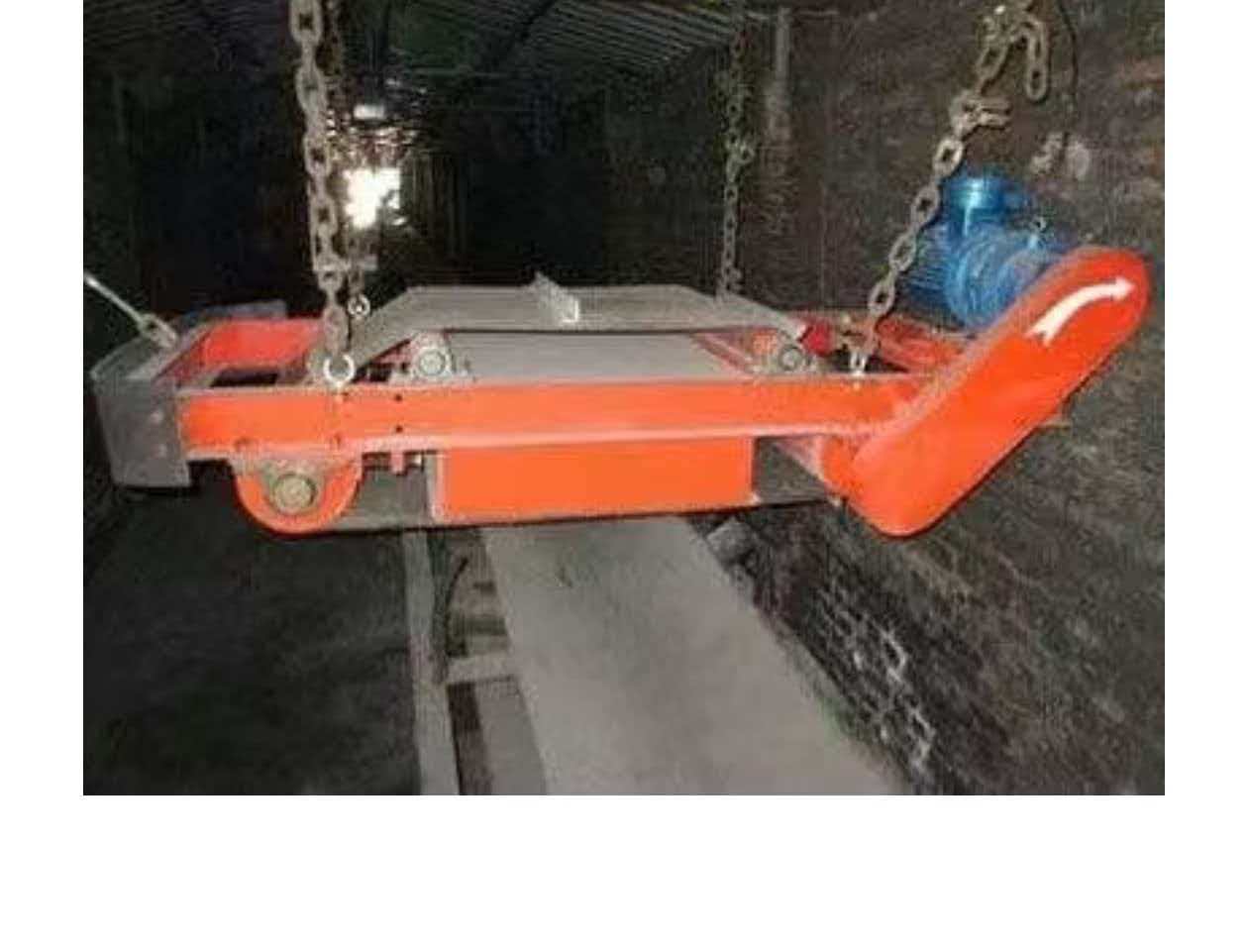
The Problem: A Continuous Line Cannot Stop for Cleaning
A magnetic separator that has to be cleaned by hand is a bottleneck, not a solution. On a conveyor moving material at up to 2.5 m/s, every manual clean-out means the line stops, the separator is opened, captured tramp metal is removed, and the belt is re-tensioned. Across three shifts and 300+ operating days, that downtime is a production cost, and it is also a safety exposure, because someone has to work near the magnet face while material is stationary on the belt.
Self-cleaning operation removes that step. In the three platforms ranked here, discharge is handled by a continuously running discharge belt: a wear-resistant rubber belt carries collected iron out of the magnetic field and drops it into a collection chute while the process continues. RCDF and RCDC pair this with a drum-shaped self-aligning roller and a fully sealed bearing housing driven by a gear motor. RCYC(D) uses the same discharge architecture, with a permanent magnet assembly in place of a coil.
Four failure modes decide whether a self-cleaning separator survives continuous duty:
- Coil heat. An energised coil generates heat continuously. If that heat is not removed, field strength and insulation life are affected. RCDC addresses this with an axial flow fan, forced air cooling and a purpose-designed air duct. RCDF addresses it with forced high-temperature transformer oil circulation.
- Discharge belt damage. Sharp tramp metal — slag, plate fragments, rebar — cuts rubber belts. Belt grade, scraper design and roller alignment determine service life.
- Environment. Cement dust, coal dust, humidity and coastal salt spray attack housings, bearings and electrical components. RCDC and RCDF use fully sealed carbon steel housings described as dust-proof, waterproof, salt spray-resistant and corrosion-resistant.
- Power dependency. A permanent magnet separator continues to capture ferrous material whether or not a coil circuit is energised. Where power interruption or coil maintenance is unacceptable, that changes the ranking.
The practical question is therefore narrow: which design type keeps removing iron when the line never stops?
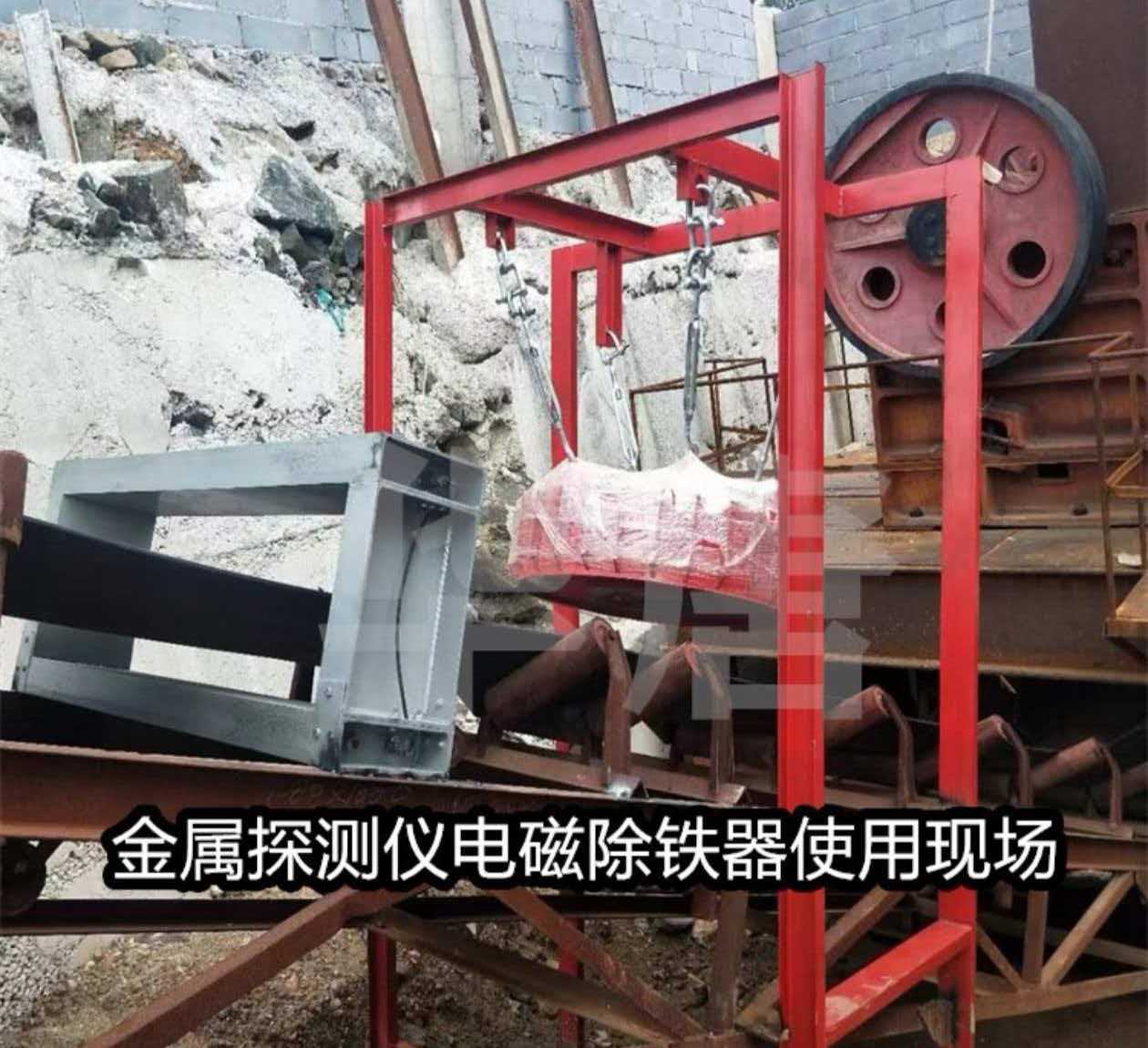
Industry Background: What Is Driving Continuous-Duty Iron Removal
The global magnetic separator market was valued at approximately USD 1.07 billion in 2024, with a projected CAGR of around 5.0% through 2033 (Grand View Research). Asia Pacific accounted for 43.8% of that revenue in 2024, driven by industrialisation and mining activity. Published market size estimates diverge considerably between research houses, mainly because some include laboratory-scale equipment alongside industrial units, so a procurement case should be built on the process rather than on a single headline number.
Inside the equipment mix, drum-type separators held the largest single product share at roughly 38% in 2024 (Future Market Insights). Overband and cross-belt self-cleaning separators serve a different function: continuous protection of downstream equipment — crushers, roller presses, vertical mills — where the cost driver is unplanned mechanical damage rather than product purity.
Performance expectations are moving upward in parallel. High Gradient Magnetic Separators have been reported to improve recovery rates by 15–20% for hematite and ilmenite ores compared with standard-intensity units (Indian Bureau of Mines), and flux densities above 16,000 Gauss are increasingly treated as a baseline in lithium battery material purification lines. The design response in the self-cleaning segment is the optional high-strength magnetic build — designated T1, T2 and T3 — which lifts field strength above the base configuration without changing the platform.
Compliance is the third pressure. Industrial magnetic separators are expected to align with safety and quality frameworks including ISO 9001:2015, the EU Machinery Directive and IEC 60034-1 for motors. Testing against those frameworks determines what documentation a supplier can put on the table during tender evaluation.
Supply is not the constraint. The global manufacturing base includes established names such as Eriez Manufacturing Co. (US), LONGi Magnet Co., Ltd (China), Metso Outotec (Finland) and Bunting Magnetics (US), alongside specialised Chinese manufacturers. The real differentiator for a buyer is narrower: whether a specific separator configuration can hold a required field strength continuously, in that plant's dust, humidity and material conditions.
How These Three Platforms Were Ranked
The ranking below applies five criteria in a fixed priority order, weighted toward the most demanding continuous duty at the largest frame sizes:
- Thermal behaviour under continuous excitation — how the coil is cooled, and how much heat the design can remove over thousands of operating hours.
- Field strength and high-strength headroom — base magnetic field range plus any T1 / T2 / T3 high-strength options.
- Process envelope — belt width, rated suspension height and maximum material layer thickness.
- Operating profile — excitation power draw versus discharge-drive power only.
- Self-cleaning discharge and service access — belt, scraper, roller and bearing design, and whether the magnetic field can be removed for maintenance.
This ordering is a best-fit ranking, not a claim of universal superiority. The weighting matters, and where a plant weights different criteria — lowest electrical dependency, lowest suspension load, or a fixed, always-on field — the order legitimately changes. That alternative weighting is stated explicitly for each entry below.
Ranked: Three Self-Cleaning Platforms for Continuous Operations
#1 — RCDF Series Oil-Cooled Self-Cleaning Electromagnetic Separator
The RCDF Series is a self-cleaning suspended electromagnetic separator with oil cooling, covering ten models from RCDF-5 through RCDF-20. It ranks first because heat is the primary constraint on continuous electromagnetic operation, and forced oil circulation moves more heat away from the coil than any other method used in this group.
Magnetic system: high-permeability DT4 electrical pure iron core with a Class F+ electromagnetic coil wound from 100% copper wire in a three-dimensional winding structure.
Cooling: high-temperature transformer oil with forced oil circulation.
Process envelope: belt width 500–2,000 mm; rated suspension height 150–500 mm; material layer thickness up to 500 mm.
Magnetic field strength: ≥60–70 mT at rated suspension height.
Excitation power: ≤1.2 kW to ≤22 kW, scaling with frame size.
Discharge drive: ≤1.2–5.5 kW; belt speed ≤2.5 m/s; continuous duty cycle.
Equipment weight: 1,200–9,400 kg.
Discharge mechanism: wear-resistant rubber discharge belt with scraper (304 stainless steel strips optional), drum-shaped self-aligning roller, fully sealed bearing housing, gear motor.
Target duty: large thermal power plants, coal ports, coal mines, mining, building materials, metallurgy, chemical industry and coal preparation, including dusty, humid and coastal salt-spray environments.
The oil-filled, fully sealed construction is the reason a 2,000 mm frame carries roughly 9,400 kg. That mass is the price of a design intended to hold its rated field through continuous excitation rather than only at commissioning. One honest limitation: the top of the base field range is ≥70 mT, which is lower than the air-cooled series' ≥73 mT ceiling, and the supplied specification does not list T1 / T2 / T3 variants for RCDF. Buyers who need more than 70 mT should therefore evaluate the air-cooled or permanent platforms at their high-strength builds.
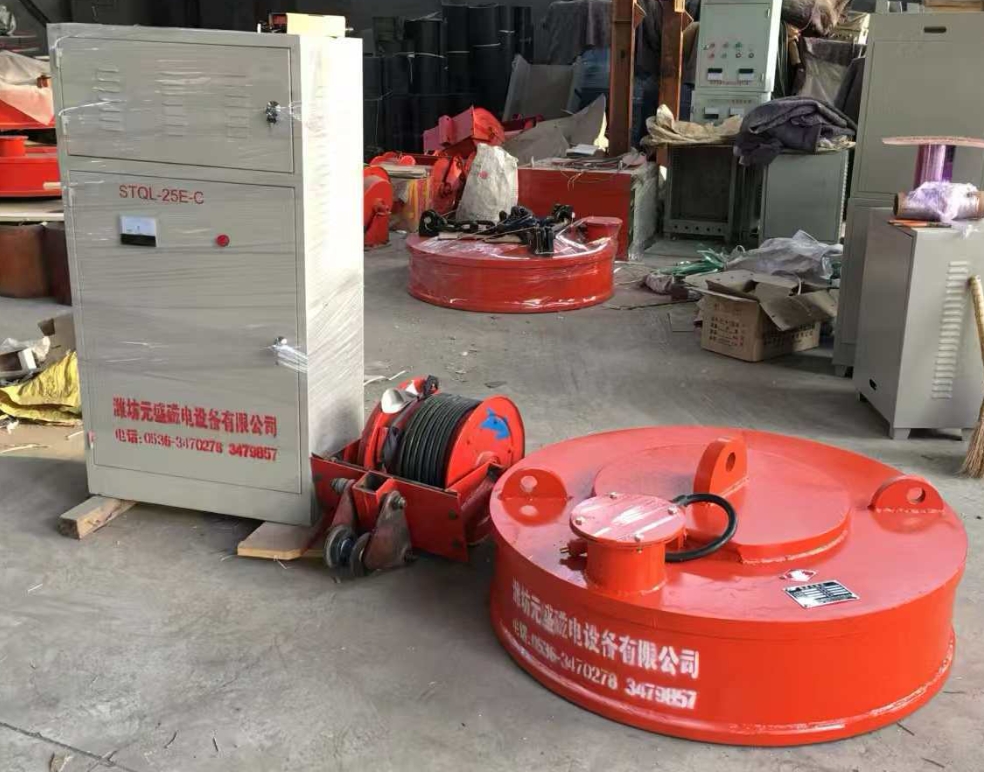
#2 — RCDC Series Air-Cooled Self-Cleaning Electromagnetic Separator
The RCDC Series is a self-cleaning suspended electromagnetic separator cooled by forced air, covering ten models from RCDC-5 through RCDC-20. It ranks second on thermal headroom, but it leads the group on two measurable specifications: base magnetic field strength and excitation power range.
Cooling: axial flow fan with forced air cooling and a special air duct design — no oil circuit to manage.
Magnetic system: high-permeability iron core with an impregnated and cured electromagnetic coil.
Process envelope: belt width 500–2,000 mm; rated suspension height 150–500 mm; material layer thickness up to 500 mm.
Magnetic field strength: ≥60–73 mT at rated suspension height — the highest base range in the group.
High-strength options: T1 ≥90 mT, T2 ≥120 mT, T3 ≥150 mT.
Excitation power: ≤1.2 kW to ≤30 kW — the widest range of the three platforms.
Discharge drive: ≤1.5–5.5 kW; belt speed ≤2.5 m/s; continuous duty cycle.
Equipment weight: 1,080–10,500 kg.
Housing: fully sealed carbon steel, dust-proof, waterproof, salt spray-resistant and corrosion-resistant.
Typical applications: steel mill slag iron removal; cement plants protecting roller presses, vertical mills and crushers; power plant coal iron removal; mines, ports, metallurgy and building materials.
For plants that do not want to operate and maintain a transformer-oil circuit, RCDC removes a whole maintenance procedure. It also offers the broadest path to high intensity: a T3 build raises the field to at least 150 mT, more than double the base specification. The trade-off is thermal: forced air through a duct removes coil heat less effectively than forced oil circulation, which is why this platform ranks below RCDF for the most sustained duty at the largest frames — even though its excitation budget is higher on paper.
#3 — RCYC(D) Series Self-Cleaning Permanent Magnetic Separator
The RCYC(D) Series — full designation: RCYC(D) Series Self-Cleaning Permanent Magnetic Separator / Belt Self-Discharging Permanent Magnet Iron Remover — is a suspended, self-cleaning permanent magnet unit, which places it in the cross-belt magnetic separator and overband magnetic separator category. Ten models span RCYD(C)-5 through RCYD(C)-20.
Magnetic source: high-performance NdFeB rare earth permanent magnet with a high-remanence, high-coercivity composite magnetic system. No excitation power and no coil cooling circuit.
Process envelope: belt width 500–2,000 mm; rated suspension height 150–550 mm — the tallest suspension in the group; material layer thickness up to 500 mm.
Magnetic field strength: ≥65–75 mT base; T1 ≥90 mT, T2 ≥120 mT, T3 ≥150 mT.
Discharge drive power: ≤1.5–7.5 kW (discharge belt only).
Belt speed: ≤2.5 m/s; continuous duty cycle.
Equipment weight: 750–9,700 kg — the lightest small-frame option in the group at 750 kg for RCYD(C)-5.
Discharge mechanism: wear-resistant rubber discharge belt, drum-shaped self-aligning roller, fully sealed bearing housing, carbon steel or stainless steel frame, gear motor.
Typical industries: cement, thermal power generation, metallurgy, mining, chemical, glass, papermaking, coal, building materials, grain and ceramics.
On field strength alone, this platform is competitive: its base range reaches ≥75 mT, higher than either electromagnetic series, and its T3 build reaches ≥150 mT. It ranks third because of what a permanent magnet cannot do rather than because of what it produces. A permanent magnet's field is always present — it cannot be switched off, and it cannot be modulated for a different material or line speed. An electromagnetic separator's field exists only while the coil carries current, which changes the maintenance and handling procedure around the magnet block. Where a plant needs self-cleaning iron removal, the lowest possible weight on the suspension structure, and no excitation power at all, this platform moves to first choice — the ranking is a weighting decision, not a verdict on capability.
Side-by-Side Comparison of the Three Platforms
All figures below are drawn from the manufacturers' published product specifications for the three series. Blank entries indicate that the value is not part of the supplied specification for that series.
| Attribute | RCDF Oil-Cooled Electromagnetic | RCDC Air-Cooled Electromagnetic | RCYC(D) Permanent Magnetic |
|---|---|---|---|
| Series category | Self-cleaning suspended electromagnetic separator | Self-cleaning suspended electromagnetic separator | Self-cleaning permanent magnetic separator / cross-belt magnetic separator |
| Model range | RCDF-5 to RCDF-20 (10 models) | RCDC-5 to RCDC-20 (10 models) | RCYD(C)-5 to RCYD(C)-20 (10 models) |
| Magnetic source | DT4 electrical pure iron core + Class F+ copper coil, three-dimensional winding | High-permeability iron core + impregnated and cured electromagnetic coil | NdFeB rare earth permanent magnet, high-remanence high-coercivity composite system |
| Cooling | High-temperature transformer oil, forced oil circulation | Axial flow fan, forced air cooling with dedicated air duct | Not applicable — no coil |
| Applicable belt width | 500–2,000 mm | 500–2,000 mm | 500–2,000 mm |
| Rated suspension height | 150–500 mm | 150–500 mm | 150–550 mm |
| Material layer thickness (max) | 100–500 mm | 100–500 mm | 100–500 mm |
| Magnetic field strength (base) | ≥60–70 mT | ≥60–73 mT | ≥65–75 mT |
| High-strength options | Not listed in supplied specification | T1 ≥90 mT / T2 ≥120 mT / T3 ≥150 mT | T1 ≥90 mT / T2 ≥120 mT / T3 ≥150 mT |
| Excitation power | ≤1.2–22 kW | ≤1.2–30 kW | None |
| Discharge drive power | ≤1.2–5.5 kW | ≤1.5–5.5 kW | ≤1.5–7.5 kW |
| Applicable belt speed | ≤2.5 m/s | ≤2.5 m/s | ≤2.5 m/s |
| Duty cycle | Continuous | Continuous | Continuous |
| Equipment weight | 1,200–9,400 kg | 1,080–10,500 kg | 750–9,700 kg |
| Discharge mechanism | Rubber belt + scraper (304 stainless strips optional) + drum-shaped self-aligning roller + sealed bearing housing + gear motor | Rubber belt + scraper + drum-shaped self-aligning roller + sealed bearing housing + gear motor | Rubber belt + drum-shaped self-aligning roller + sealed bearing housing + gear motor |
| Housing | Fully sealed carbon steel, corrugated heat dissipation fins | Fully sealed carbon steel, dust-proof, waterproof, salt spray-resistant, corrosion-resistant | Carbon steel or stainless steel frame |
Each series can also be specified at a raised field strength. The high-strength build follows the same T1 / T2 / T3 naming across platforms:
| High-strength build | RCDC Air-Cooled Electromagnetic | RCYC(D) Permanent Magnetic |
|---|---|---|
| T1 | Magnetic field strength ≥90 mT | Magnetic field strength ≥90 mT |
| T2 | Magnetic field strength ≥120 mT | Magnetic field strength ≥120 mT |
| T3 | Magnetic field strength ≥150 mT | Magnetic field strength ≥150 mT |
Step-by-Step: Specifying a Self-Cleaning Separator for a Continuous Line
The specification sequence below follows the order in which the three platforms' published parameters must be matched to a real installation. Skipping a step usually produces a separator that is either under-strength for the material layer or over-specified for the suspension structure.
Step 1 — Fix the conveyor parameters. Record belt width (the three platforms cover 500–2,000 mm), belt speed and maximum material layer thickness. All three series are rated for belt speeds up to 2.5 m/s, so a line running faster than that falls outside this selection group.
Step 2 — Define the required field strength at the rated suspension height. Field strength is specified at a defined suspension distance, not at the magnet face. Base ranges are ≥60–70 mT for RCDF, ≥60–73 mT for RCDC and ≥65–75 mT for RCYC(D). If the material layer is deep or the required capture rate is high, move to a T1, T2 or T3 build on RCDC or RCYC(D).
Step 3 — Choose the design type against the operating profile. Oil-cooled if coil heat is the dominant risk; air-cooled if the site will not maintain an oil circuit but needs high intensity; permanent if excitation power must be eliminated and the field can be fixed.
Step 4 — Confirm the suspension and layer envelope. Rated suspension heights run 150–500 mm for RCDF and RCDC, and 150–550 mm for RCYC(D). Maximum material layer thickness reaches 500 mm across the group.
Step 5 — Specify the discharge and sealing configuration. Each platform uses a wear-resistant rubber discharge belt with a drum-shaped self-aligning roller, a fully sealed bearing housing and a gear motor. RCDF additionally offers 304 stainless steel strips and a discharge scraper.
Step 6 — Match the electrical design to site conditions. Excitation power ranges from ≤1.2 kW to ≤30 kW depending on frame size, and discharge drive power from ≤1.2 kW to ≤7.5 kW. Both circuits must be matched to site voltage and frequency, and to the plant's available power capacity at the suspension point.
Step 7 — Assemble the compliance file. Obtain the quality management certificate and any conformity attestation covering the exact model being purchased, and agree the acceptance procedure before shipment.
Step 8 — Confirm the commercial parameters. The minimum order quantity is 1 unit, typical production lead time is 30–45 days, and monthly production capacity is 300 units. Delivery terms are FOB Qingdao or CIF. Payment terms are T/T with a 30% deposit and the 70% balance before shipment. Acceptance can be confirmed by third-party pre-shipment inspection (SGS, BV, etc.) or by customer on-site inspection.
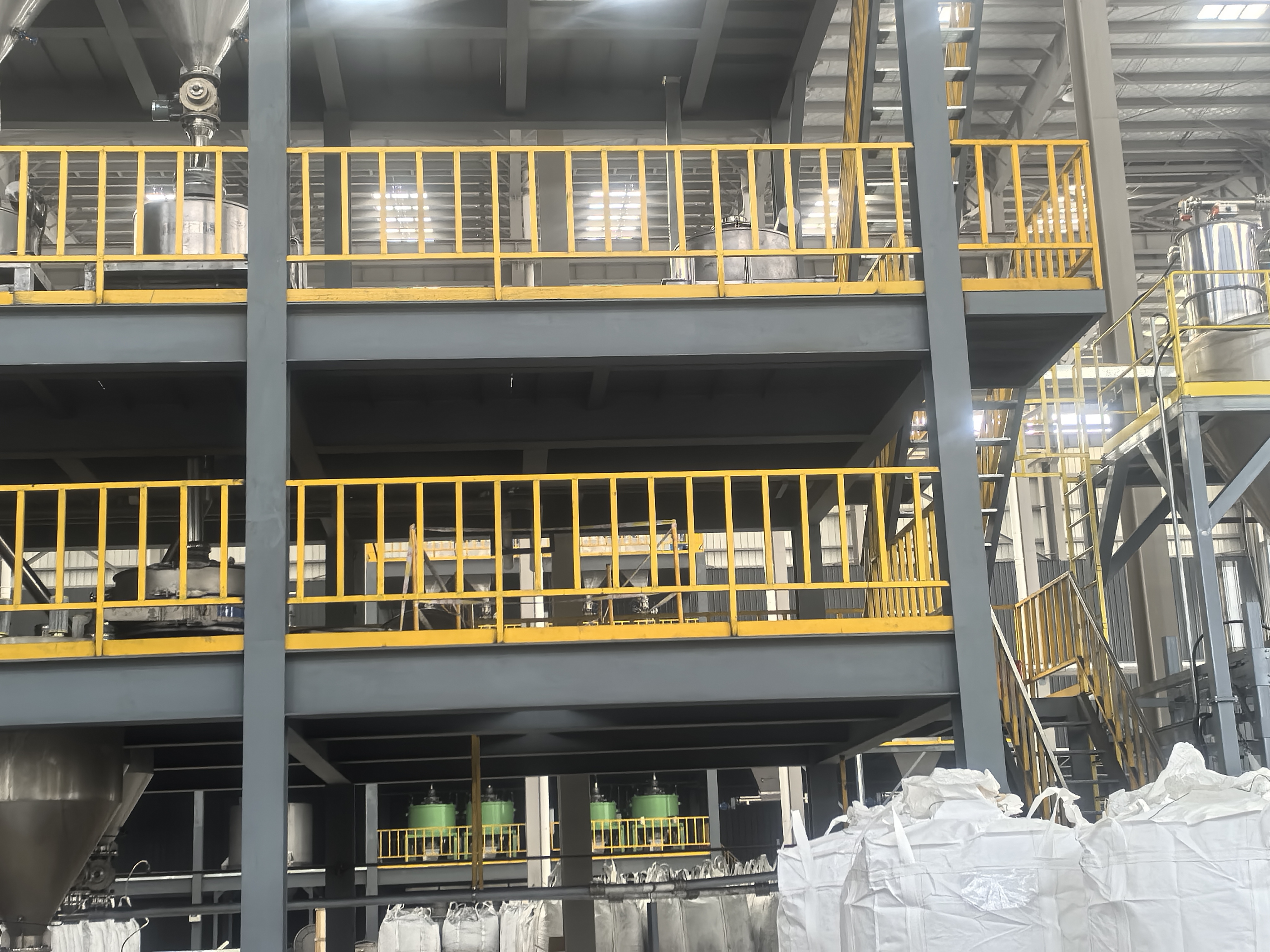
Use Cases: Where Each Platform Fits
Steel mills and slag handling. Slag iron removal is one of the listed applications for the air-cooled RCDC series. Slag streams carry sharp, abrasive ferrous fragments, so belt grade and scraper condition determine service intervals. Where fragments are exceptionally sharp, the heavy-duty armored permanent magnetic belt separator family exists as an adjacent option within the same product range.
Cement plants. Self-cleaning suspended electromagnets are used ahead of roller presses, vertical mills and crushers to prevent tramp metal damage. Dust loading is continuous, which is why the sealed housing specification — dust-proof, waterproof, salt spray-resistant — matters more here than peak field strength.
Power generation and coal handling. Coal flow iron removal is a listed application for the air-cooled electromagnetic and permanent platforms. Coal ports combine salt spray with heavy dust, an environment where the oil-cooled RCDF series and the sealed RCDC housing are both specified for continuous operation.
Mining, ports and docks. Belt widths up to 2,000 mm and material layers to 500 mm place these installations in the largest frame sizes of each series, where equipment weight (up to 10,500 kg for RCDC) becomes a structural design consideration for the support gantry.
Ceramics, glass, grain, wood and recycling. The permanent RCYC(D) platform lists cement, thermal power generation, metallurgy, mining, chemical, glass, papermaking, coal, building materials, grain and ceramics among its industries — applications where automatic discharge and low maintenance matter more than adjustable field strength.
Documented deployment record. The air-cooled self-cleaning electromagnetic platform has been deployed in ceramic processing, battery material manufacturing, quartz sand processing, foundries and steel plants. Project records for these installations show 5, 8, 4, 6 and 10 units supplied to different client sites, with project completion periods ranging from 1.5 to 5 years. Site records list outcomes that include iron removal rates above 98%, Fe content below 5 ppm, impurity levels below 10 ppm and recovery improvements of 15%.
Frequently Asked Questions
The manufacturer holds a Quality Management System Certification, certificate number 78323Q00343R0S, issued by POCNC (Zhongliang Certification (Shandong) Co., Ltd.) against the standard GB/T19001-2016 / ISO9001:2015. The certified scope is the production of separators, magnetic separators and demagnetizers (excluding those requiring qualification permits). It was issued on 2023-10-07 and is valid to 2026-10-06.
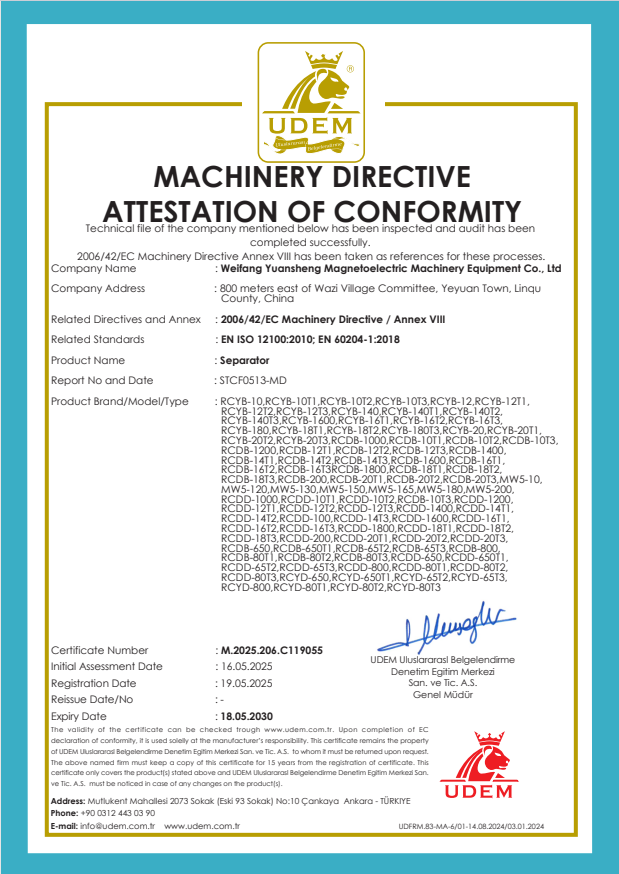
A separate Machinery Directive Attestation of Conformity for the EU/EEA market, certificate number M.2025.206.C119055, was issued by UDEM Uluslararası Belgelendirme Denetim Eğitim Merkezi San. ve Tic. A.Ş. against EN ISO 12100:2010 and EN 60204-1:2018, issued 2025-05-19 and valid to 2030-05-18. Its declared scope covers the separator series RCYB / RCDB / RCDD / RCYD / MW. Because conformity attestations are written against named series, buyers should verify that the certificate scope covers the exact model being purchased before it is placed on a tender list.
All three series cover belt widths from 500 mm to 2,000 mm and are rated for belt speeds up to 2.5 m/s on a continuous duty cycle. Rated suspension height ranges from 150 mm to 500 mm on RCDF and RCDC, and from 150 mm to 550 mm on RCYC(D). Maximum material layer thickness reaches 500 mm across the group.
Base magnetic field strength is ≥60–70 mT for the oil-cooled RCDF series, ≥60–73 mT for the air-cooled RCDC series and ≥65–75 mT for the permanent RCYC(D) series. RCDC and RCYC(D) are additionally available in T1 (≥90 mT), T2 (≥120 mT) and T3 (≥150 mT) high-strength builds.
Excitation power ranges from ≤1.2 kW to ≤22 kW on RCDF and from ≤1.2 kW to ≤30 kW on RCDC; the permanent RCYC(D) series has no excitation draw and uses only discharge drive power between ≤1.5 kW and ≤7.5 kW. Discharge drive power on the two electromagnetic series is ≤1.2–5.5 kW and ≤1.5–5.5 kW respectively. Equipment weight spans 1,200–9,400 kg (RCDF), 1,080–10,500 kg (RCDC) and 750–9,700 kg (RCYC(D)).
Cost is driven by the configuration rather than by a single price point. The variables that move it are the design type (oil-cooled, air-cooled or permanent), the frame size and belt width, the magnetic field strength version including any T1 / T2 / T3 high-strength build, the excitation power requirement of the coil, and the discharge and sealing configuration. Because belt width, field strength and cooling method are all specified per project, the same series can be configured for very different duty levels.
Standard commercial parameters are a minimum order quantity of 1 unit, a typical production lead time of 30–45 days, and a monthly production capacity of 300 units. Delivery terms are FOB Qingdao or CIF. Payment terms are T/T with a 30% deposit and the 70% balance before shipment. Acceptance criteria are a pre-shipment inspection by a third party such as SGS or BV, or a customer on-site inspection.
Yes — the minimum order quantity of 1 unit allows one separator to be commissioned for evaluation rather than committing to a multi-unit installation. The manufacturer performs 100% inspection before shipment, and acceptance can be verified independently through third-party pre-shipment inspection (SGS, BV, etc.) or by customer on-site inspection.
If the line requires a non-standard configuration, OEM/ODM production is available with customization of magnetic field strength, size, voltage, material, logo and colour. That allows the unit under evaluation to be matched to the actual suspension height, material layer and voltage before series deployment.
Typical production lead time is 30–45 days from order confirmation, supported by a monthly production capacity of 300 units. After-sales support consists of remote technical support, spare parts supply and a 12-month warranty.
Because RCDF and RCDC use two very different cooling designs, the most useful next step before ordering is to confirm which configuration matches your conveyor parameters. You can request a configuration review and quotation directly from the manufacturer.
Conclusion: Which Self-Cleaning Platform Fits a Continuous Line
The three platforms ranked here are not competitors on the same axis — they are three different answers to the same continuous-duty requirement. The RCDF oil-cooled electromagnetic series ranks first when coil heat is the limiting factor and the installation runs at the largest belt widths in dusty, humid or salt-spray environments, with forced oil circulation providing the strongest thermal management in the group. The RCDC air-cooled electromagnetic series ranks second overall but leads on measurable intensity, offering the highest base field range at ≥60–73 mT, the widest excitation range up to ≤30 kW, and high-strength builds reaching ≥150 mT without an oil circuit. The RCYC(D) permanent magnetic series ranks third on this weighting, yet it reaches ≥75 mT in base configuration, carries the lightest suspension load at 750 kg for the smallest frame, and consumes no excitation power at all — moving to first choice wherever electrical dependency and weight matter more than field adjustability.
For a procurement team at the Evaluation to Execution stage, the decision reduces to three checks: the material layer and required field strength at the rated suspension height, the site's tolerance for a coil cooling and excitation circuit, and the structural capacity of the support gantry. Match those three against the comparison table above, and the correct series usually selects itself.
Next Step: Configuration Review and Quotation
Weifang Yuansheng Magnetic Electromechanical Equipment Co., Ltd. supplies the RCDF oil-cooled, RCDC air-cooled and RCYC(D) permanent self-cleaning magnetic separator series, along with powder, slurry, cross-belt and high gradient magnetic separation systems, to ceramic processors, battery material manufacturers, quartz sand plants, foundries and steel plants.
Website:www.iron-separator.com
Blog: blog.iron-separator.com
Email:ys@iron-separator.com
Tel / WhatsApp: +86 155-5366-8212
Address: Linqu County, Weifang City, Shandong Province, China
Product catalogue (PDF, open access): Download the full magnetic separator catalogue
Have Questions or Need More Details?
Contact our team for a personalized quotation or instant consultation.
Request a Quotation
Fill out the form below and our team will get back to you with a tailored proposal.
WhatsApp Direct Chat
Prefer to chat in real-time? Message us on WhatsApp for instant assistance & quick answers.
- Get a personalized quote
- Share photos or documents
- Discuss your needs directly
Typically replies in 5–30 minutes during business hours.