
Regional Compliance for Industrial Magnetic Separators: A Guide to Certifications and Standards
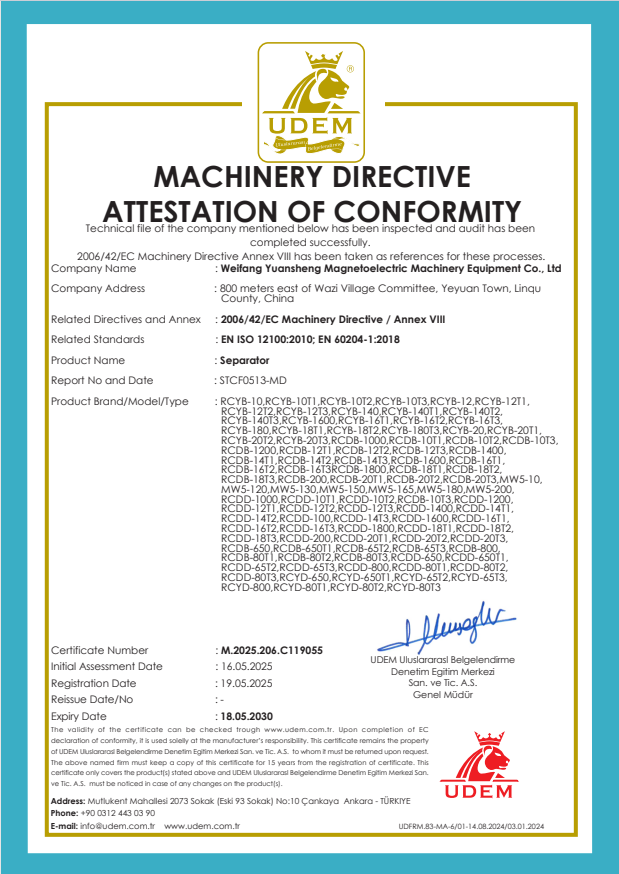
EU CE Machinery Directive attestation covering the RCYB / RCDB / RCDD / RCYD / MW separator series — a document most buyers request by name and fewer read in full.
Compliance for an industrial magnetic separator is not a single supplier badge. It is a set of documents that differ by region and by model. Buyers receive confusing paperwork because suppliers conflate ISO 9001 with CE, or quote a certificate that does not actually cover the model being purchased. This guide breaks down the certification layers that matter, shows how three common separator technologies — RCDC electromagnetic, RCYB permanent suspended, and YSDC dry powder electromagnetic — sit inside different compliance regimes, and gives a practical step-by-step checklist for verifying supplier documentation before a purchase order is signed.
Why “we are certified” is not a usable answer
The most common answer a procurement manager hears is that “our machines are certified.” That phrase can mean an ISO 9001 quality system, a CE mark, a local electrical approval, an internal factory test, or a mixture of all four — and each carries different legal weight. When an incident, an inspection, or a cross-border shipment is at stake, only the specific document that matches the region and the model carries weight.
The gap is concrete. ISO 9001:2015 is a quality management system certification: it confirms the supplier's production process is managed, not that a particular machine is safe under a regional machinery standard. The CE mark is a regional mark that depends on a declared conformity with specific standards. Export classification depends on the harmonized system code, which for magnetic separators is HS 847410. These four document types are not interchangeable.
In the industrial magnetic separator context, the confusion surfaces at three points: machines shipped across regions, machines built on permanent versus electromagnetic principles, and machines that touch wet slurry versus dry powder. The regional sections and verification checklist below address each of these points separately.
The regulatory landscape buyers are actually navigating
At the macro level, the separator category continues to grow. A commercial research estimate places the global magnetic separator market at roughly USD 1.07 billion in 2024, with Asia Pacific holding around 43.8% of revenue share. That share concentrates Chinese-manufactured separators within global procurement flows and explains why cross-regional compliance checks have become routine rather than exceptional.
For procurement, the landscape breaks into four layers:
- Management system standards. ISO 9001:2015 applies across all markets. It describes how the supplier manages design, production, and traceability. It is system-level evidence, not product-level evidence.
- Regional machinery safety. The EU/EEA relies on the Machinery Directive framework. Machines placed on that market typically require a declaration of conformity referencing specific harmonized standards — for example EN ISO 12100:2010 for risk assessment and risk reduction and EN 60204-1:2018 for electrical equipment of machines. These standards address safe operation of the equipment, not magnetic performance alone.
- Local electrical and installation regulations. These vary by installation country and site. Buyers typically need to verify against local facility codes — a layer the supplier cannot universally prove at the national level.
- Trade classification. Magnetic separators traded internationally are classified under HS 847410 (sorting, screening, separating or washing machines). Correct HS coding is basic for export declaration and helps keep documentation consistent.
These layers do not collapse into each other. A strong ISO 9001 system does not substitute for a machinery directive declaration, and a CE declaration does not substitute for site-specific electrical code information.
The two certificates that do most of the work

ISO 9001:2015 certificate 78323Q00343R0S, issued by POCNC (Zhongliang Certification (Shandong) Co., Ltd.), covering the production of separators, magnetic separators, and demagnetizers.
For the supplier discussed on this page — Weifang Yuansheng Magnetic Electromechanical Equipment Co., Ltd., a magnetic and electrical separation equipment manufacturer based in Linqu County, Weifang City, Shandong Province, China — two documents are requested most frequently: the ISO 9001:2015 certificate and the EU Machinery Directive attestation. Understanding what each one covers — and what it does not — is the first step in verification.
ISO 9001:2015 quality management system
The firm holds a Quality Management System Certification Certificate numbered 78323Q00343R0S, issued by POCNC (Zhongliang Certification (Shandong) Co., Ltd.) under standard GB/T19001-2016/ISO9001:2015. The certified scope is the production of separators, magnetic separators, and demagnetizers (excluding those requiring qualification permits). The issue date is 2023-10-07 with an expiry date of 2026-10-06.
That has two implications for a buyer. First, the scope statement matches magnetic separation equipment — which matters, because some suppliers cite an ISO 9001 certificate that actually covers only maintenance or trading activity rather than equipment production. Second, the expiry date shown on the certificate has passed; buyers should always check the current renewal file rather than rely on an older scan.
What the certificate does not do is certify a specific product. A single ISO 9001 certificate can cover multiple product lines; it is not evidence that any one model meets regional machinery safety requirements.
EU Machinery Directive attestation
For shipments into the EU/EEA, the firm holds a Machinery Directive Attestation of Conformity numbered M.2025.206.C119055, issued by UDEM Uluslararası Belgelendirme Denetim Eğitim Merkezi San. ve Tic. A.Ş. The standards referenced are EN ISO 12100:2010 and EN 60204-1:2018. The covered series is stated as RCYB / RCDB / RCDD / RCYD / MW. The issue date is 2025-05-19 and validity runs to 2030-05-18.
The most important detail for a buyer is the scope. The covered series are RCYB / RCDB / RCDD / RCYD / MW. The RCDC air-cooled self-cleaning electromagnetic separator and the YSDC dry electromagnetic powder system are not named on this specific document. Within an EU/EEA compliance pack, that means a buyer sourcing RCDC or YSDC should ask for supplementary documentation, or confirm explicitly whether the model is covered under a different file or must be assessed separately for the project. This is the single most common omission at first inquiry.
The standards section is also worth understanding. EN ISO 12100:2010 addresses risk assessment and risk reduction; EN 60204-1:2018 addresses the electrical equipment of machines. Both are general machinery safety standards. They do not address magnetic performance — that is covered separately by product data sheets and test reports, and, where they exist, industry-specific standards.
How compliance changes across the three separator technologies
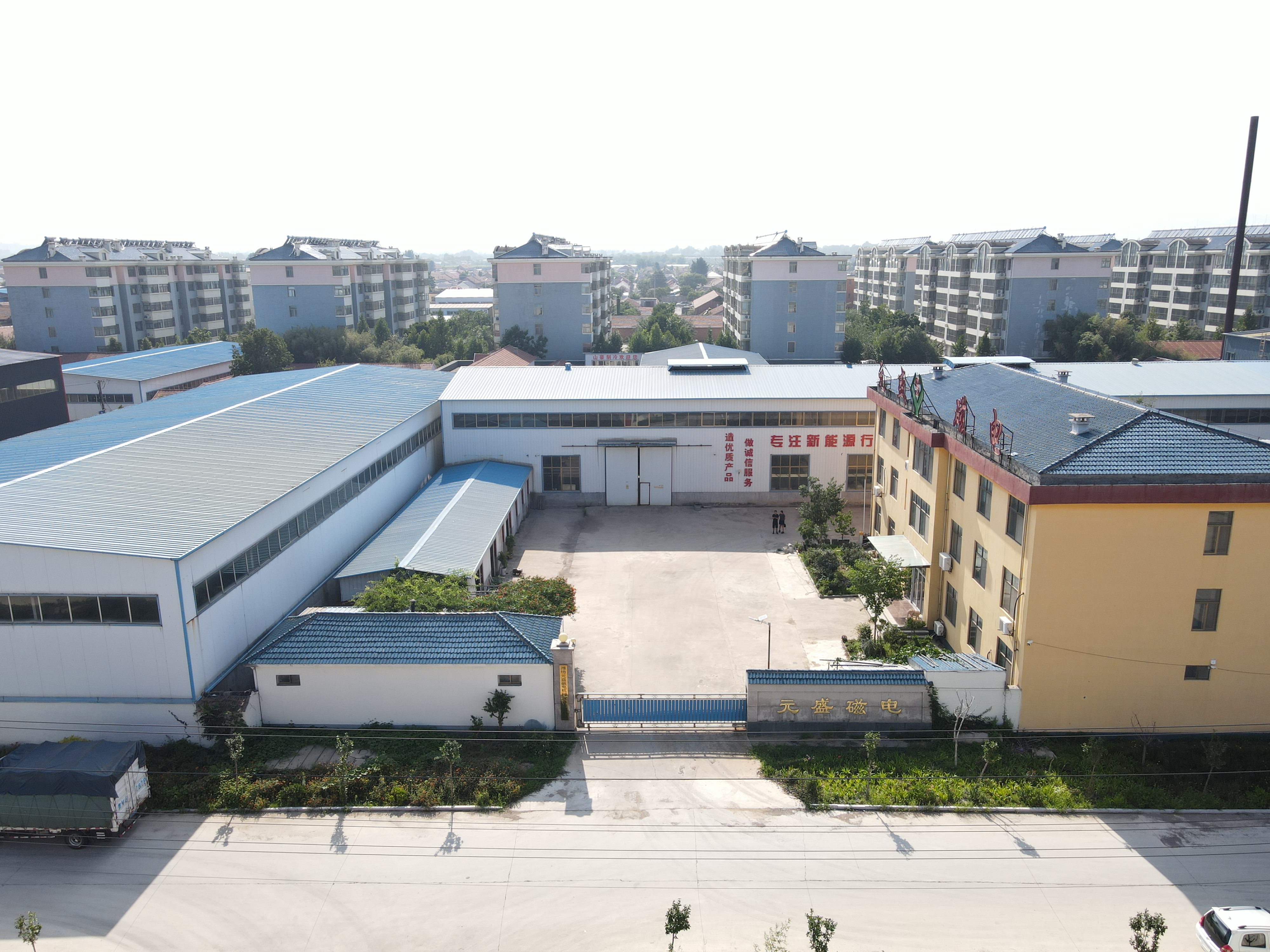
Manufacturing base of Weifang Yuansheng Magnetic Electromechanical Equipment Co., Ltd. in Linqu County, Shandong Province — the production site referenced in the ISO 9001 scope.
RCDC series air-cooled self-cleaning electromagnetic separator
The RCDC series is a suspended electromagnetic separator with forced air cooling and a self-cleaning discharge belt. Published specifications show belt widths of 500–2000 mm, rated suspension heights of 150–500 mm, magnetic field strength ≥60–73 mT, excitation power ≤1.2–30 kW, drive power ≤1.5–5.5 kW, and belt speed ≤2.5 m/s. Models with higher magnetic strength are available (Type T1 at ≥90 mT, T2 at ≥120 mT, T3 at ≥150 mT).
From a compliance angle, the RCDC is the case that exposes the difference between a system certificate and a product certificate. The ISO 9001 certificate covers production as a process, which includes the RCDC under the production scope in general terms, but the CE attestation does not name RCDC in its covered series list. Buyers using the RCDC in an EU/EEA project therefore have two options: ask the supplier for a specific attestation covering the model, or commission a project-level assessment against EN ISO 12100:2010 and EN 60204-1:2018 before installation. Both are legitimate, but the choice should be made before a purchase order — not after shipment.
RCYB series suspended permanent magnetic separator
The RCYB series is a suspended permanent magnetic separator for manual iron cleaning. Published specifications show belt widths of 400–1600 mm, rated suspension heights of 130–450 mm, magnetic field strength ≥45–70 mT, belt speed ≤2.5 m/s, and weight 115–2880 kg. Higher-strength types (T1 ≥90 mT, T2 ≥120 mT, T3 ≥150 mT) are available as options.
Because RCYB is named in the CE attestation scope, the compliance story for this series is more straightforward for EU/EEA buyers. The remaining verification steps are the ones a buyer should still complete: confirm the validity of the certificate at the current date, confirm that the specific sub-model number appears within the named series, and confirm the electrical fittings used in the installation meet the site’s local requirements — which the manufacturer cannot establish for a site it has not seen.
YSDC series dry electromagnetic powder iron removal system
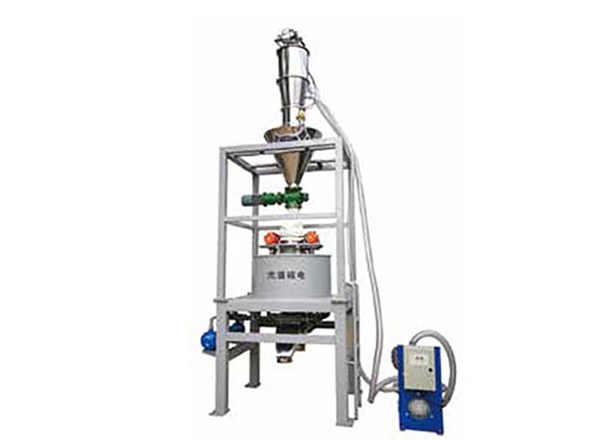
YSDC series dry electromagnetic powder iron removal system — a configuration typically used for lithium battery materials, fine chemicals, ceramics, and non-metallic mineral powders.
The YSDC series is a dry electromagnetic powder system intended for high-purity powder processing in lithium battery materials, fine chemicals, ceramics, and non-metallic minerals. Published specifications show magnetic induction of 16000–20000 Gauss, input voltage AC380V 50Hz three-phase four-wire, excitation power ≤3.9 kW to ≤24.5 kW depending on model, production capacity 0.2–10 t/h, and mainframe weight 850–3700 kg.
The compliance dimension for the YSDC is different from the RCDC in one important way. Industry analysis cited for lithium battery material purification indicates that high-gradient electromagnetic separation in this segment typically requires magnetic field strengths above 16,000–20,000 Gauss — which the YSDC range meets — but the machinery-safety side of compliance is often under-documented. The YSDC is not named in the CE attestation scope on this page. Buyers in EU/EEA projects sourcing YSDC should expect to supply additional project-level documentation, and buyers in other regions should verify the handling precautions for fine powders against local dust-explosion and electrical regulations.
Step-by-step: how to verify a supplier’s compliance file
The following sequence works for a magnetic separator purchase in most regions. It is designed to surface gaps at inquiry stage rather than at receiving inspection.
- Define the destination regime first. Before reading a single certificate, establish where the machine will be installed, and which layers of compliance apply: management system, regional machinery safety, local electrical code, and trade classification. This tells you which documents to request.
- Ask a structured question. Rather than “are you certified?”, ask: “Which certificate covers this specific model series, and can you send the scan with the covered-series list visible?” This forces a scoped answer rather than a marketing one.
- Read the coverage, not the logo. Certificates name the covered product family. Compare that list against your purchase model. If the model is not on the list, ask what covers it — a separate certificate, a project assessment, or a written statement.
- Check the standard, not just the certificate title. ISO 9001:2015 with GB/T19001-2016 is a management-system standard; EN ISO 12100:2010 and EN 60204-1:2018 are machinery-safety standards. Match the standard cited on the certificate with the standard your destination regime actually requires.
- Check validity at the current date. Every certificate carries an issue date and an expiry date. The ISO 9001 certificate discussed above shows an expiry of 2026-10-06. Confirm the renewal status before quoting a certificate in your project file.
- Confirm the HS code matches your customs entry. Magnetic separators are classified under HS 847410. Mismatch between the supplier’s invoice HS code and your import declaration is a customs risk that is independent of the mechanical certificate.
- Put the documentation into the purchase order. List the documents you require — ISO 9001, the specific attestation, model naming, HS code, packaging and electrical data — as delivery conditions in the PO, not as an informal request. This converts a compliance question into a contractual one.
Application scenarios by region
The regional emphasis differs enough that a single generic compliance pack is not practical. Here is how the verification priorities shift.
EU/EEA buyers
Priority is the Machinery Directive attestation. Buyers should confirm three things: the covered series list includes the model being purchased, the referenced standards are the machinery-safety standards (EN ISO 12100:2010 and EN 60204-1:2018), and the certificate is within its validity period. For RCDC or YSDC models not named on the attestation, the practical route is a written supplier statement plus a project-level conformity assessment before installation. Buyers should also confirm the declaration of conformity is supplied with the shipment, as that is the document that accompanies the machine into the EU/EEA market.
China and Asia-Pacific buyers
ISO 9001:2015 is the baseline expectation, and buyers should confirm the certificate’s scope statement actually covers separator production rather than adjacent activity. Because the manufacturing base for many suppliers is concentrated in China — with the Shandong cluster being a major production center — a buyer visiting the factory can ask to see the certificate in its issued form rather than a marketing scan. Where destination-specific electrical requirements apply, the supplier may also need to provide electrical data consistent with local voltage and protection standards.
North America and other international destinations
For shipments to destinations other than the EU/EEA or China, the emphasis is on trade classification and installation-site compliance. HS 847410 should appear on the commercial invoice and packing list. Beyond that, the buyer’s own jurisdiction often governs electrical safety and local factory regulations, so the supplier’s role is to provide machine electrical data and a documented statement of shipping configuration rather than a regional mark. Buyers should not assume that an EU attestation automatically satisfies a North American installation requirement.
Lithium battery and high-purity processing buyers
For high-gradient and powder-iron-removal equipment used in battery material lines, compliance documentation takes on an additional product-quality dimension. The industry reference level for high-gradient electromagnetic separators is typically magnetic field strength above 16,000–20,000 Gauss, and the YSDC range is on record at 16000–20000 Gauss. Buyers should ask for the test report corresponding to the delivered model, plus the electrical and material-contact specifications, so that the compliance file includes both the safety dimension and the purity dimension.
Comparison table: which document covers which series
| Product series | Technology type | Magnetic performance (published data) | ISO 9001:2015 coverage | EU Machinery Directive attestation | Buyer verification step |
|---|---|---|---|---|---|
| RCDC Series | Air-cooled self-cleaning electromagnetic, suspended | Belt width 500–2000 mm; magnetic field ≥60–73 mT; excitation power ≤1.2–30 kW | Covered under production scope | Not named in the covered series list | Request supplementary attestation or project-level assessment |
| RCYB Series | Suspended permanent magnetic, manual cleaning | Belt width 400–1600 mm; magnetic field ≥45–70 mT; weight 115–2880 kg | Covered under production scope | Named in the covered series | Confirm current validity and that the specific sub-model is inside the series |
| YSDC Series | Dry electromagnetic powder iron removal | Magnetic induction 16000–20000 Gauss; capacity 0.2–10 t/h; AC380V 50Hz | Covered under production scope | Not named in the covered series list | Request product safety file, powder handling review, and project confirmation |
The underlying point of the table is not that one series is more or less compliant than another. It is that compliance is scoped per document per series, and the buyer’s task is to match the document to the purchase. A supplier who can answer the “what is covered” question precisely is generally a safer supplier than one who answers the “are you certified” question confidently.
FAQ
What documentation should an industrial magnetic separator supplier provide for regional compliance?
The applicable set depends on the destination. For most markets, the baseline is an ISO 9001:2015 quality management system certificate. For the EU/EEA, buyers typically also require a Machinery Directive Attestation of Conformity, with a declaration of conformity accompanying the machine. For international shipment, the commercial invoice and packing list should carry HS code 847410. Buyers should verify that the certificate’s covered series actually names the model being purchased, and confirm the expiry date at the current date rather than relying on a marketing scan.
Does an ISO 9001 certificate prove that a specific separator model complies with machinery safety standards?
No. ISO 9001:2015 is a quality management system standard. It confirms that the supplier’s design, production, and traceability processes are managed, but it is not a product-level certification. Machinery safety compliance for a specific model requires a separate regional document — for the EU/EEA, a Machinery Directive attestation referencing EN ISO 12100:2010 and EN 60204-1:2018. The two certificate types answer different questions and neither substitutes for the other.
How does regional compliance affect the total procurement budget for magnetic separators?
It typically affects engineering and documentation rather than a fixed certification fee. The budget-relevant items are: preparation or translation of conformity documentation, any additional testing required by the destination market, electrical component localization to local voltage and protection standards, and the administrative work of aligning invoice HS codes and shipment documents. Buyers should treat these as project costs at the quotation stage rather than discovering them during shipment clearance. For multi-unit or high-purity projects, the documentation cost also scales with the number of distinct models in the order.
Can a buyer verify compliance on a sample before placing a production order?
Yes, and the sample stage is the right time to do it. At the sample stage, requests should include the ISO 9001 certificate in its issued form, the Machinery Directive attestation with the covered-series list visible, and the product data sheet matching the delivered model. Inspection of the sample can then be combined with document review. The point to watch is that sample documentation sometimes differs from production documentation — buyers should confirm that the documents associated with the sample will apply unchanged to the production batch.
Do compliance documents affect lead time, and when should they be requested?
They can affect final lead time, because documentation is normally prepared in parallel with production rather than after it. The practical window is between the confirmed purchase order and the pre-shipment inspection: that is when certificates, declarations, HS coding, and packing documents are assembled. Buyers should request the compliance pack at the inquiry stage so that any scope gap — for example an RCDC model not named on the current attestation — can be resolved before the production schedule is fixed. This is also the stage to request the product catalogue or brochure for cross-checking model data.
Conclusion
Regional compliance for industrial magnetic separators is a matching exercise, not a single badge. The ISO 9001:2015 certificate proves that the production process is managed; the EU Machinery Directive attestation proves that named series meet specific machinery-safety standards; the HS code proves that the shipment classification is correct. None of these three replaces another, and each has a scope that must be read.
For buyers evaluating suppliers in the research-to-evaluation stage, the most valuable habit is to ask scoping questions early: which series, which certificate, which standard, which validity date. A supplier like Weifang Yuansheng Magnetic Electromechanical Equipment Co., Ltd. — with a China-based manufacturing footprint, a stated export share, and established documentation for its RCYB, RCDB, RCDD, RCYD and MW separator families — can answer these questions precisely when they are asked precisely. The same holds for assessing RCDC and YSDC models, where the answer will often be that the certificate covers production but not the model series, and a separate project-level assessment is needed.
That outcome is not a problem. It is a normal output of a serious compliance review, and it is better discovered at inquiry than at import clearance.
Need a compliance file for a specific separator project?
Share your destination market and the model series under evaluation, and the team can confirm which certificates apply, which standards are referenced, and what supplementary documentation a project would need before shipment. The full product catalogue is also available for download.
Download the product brochure (PDF)
Weifang Yuansheng Magnetic Electromechanical Equipment Co., Ltd. · Linqu County, Weifang City, Shandong Province, China · www.iron-separator.com · ys@iron-separator.com
Have Questions or Need More Details?
Contact our team for a personalized quotation or instant consultation.
Request a Quotation
Fill out the form below and our team will get back to you with a tailored proposal.
WhatsApp Direct Chat
Prefer to chat in real-time? Message us on WhatsApp for instant assistance & quick answers.
- Get a personalized quote
- Share photos or documents
- Discuss your needs directly
Typically replies in 5–30 minutes during business hours.