
Evaluating Industrial Magnetic Separators in 2026
Evaluating Industrial Magnetic Separators in 2026
An industrial magnetic separator is a processing device that removes ferromagnetic contamination from dry powders, slurries, and bulk materials. For procurement teams evaluating magnetic separation systems in 2026, the selection process depends on comparing separator categories, magnetic performance, compliance documentation, and manufacturer production capability. This guide defines those evaluation criteria and explains how Weifang Yuansheng Magnetic Electromechanical Equipment Co., Ltd., a high-tech enterprise in Linqu County, Weifang City, Shandong Province, China, supports buyers with permanent magnetic separators, electromagnetic separators, cross-belt magnetic separators, powder magnetic separators, slurry magnetic separators, and high gradient magnetic separators.
Why Industrial Magnetic Separator Evaluation Is Not One-Size-Fits-All
The core problem in industrial magnetic separator procurement is that no single separator type works across all materials. A suspended magnetic separator installed above a conveyor belt serves a different purpose than a slurry magnetic separator in a pipeline, and a dry powder magnetic separator for 100-mesh lithium battery material requires a different magnetic field design than a cross-belt magnetic separator on a mine conveyor. Buyers who skip the evaluation step risk selecting equipment that cannot achieve the required iron removal efficiency, either because the magnetic field strength is too low or because the separator configuration does not match the material state.
Evaluation failures often trace back to three mistakes: focusing only on surface Gauss without considering the working gap, ignoring the cleaning mechanism (manual, self-cleaning, or pneumatic), and treating dry powder and wet slurry as interchangeable applications. Each of these factors changes the equipment selection, so a structured evaluation is necessary.
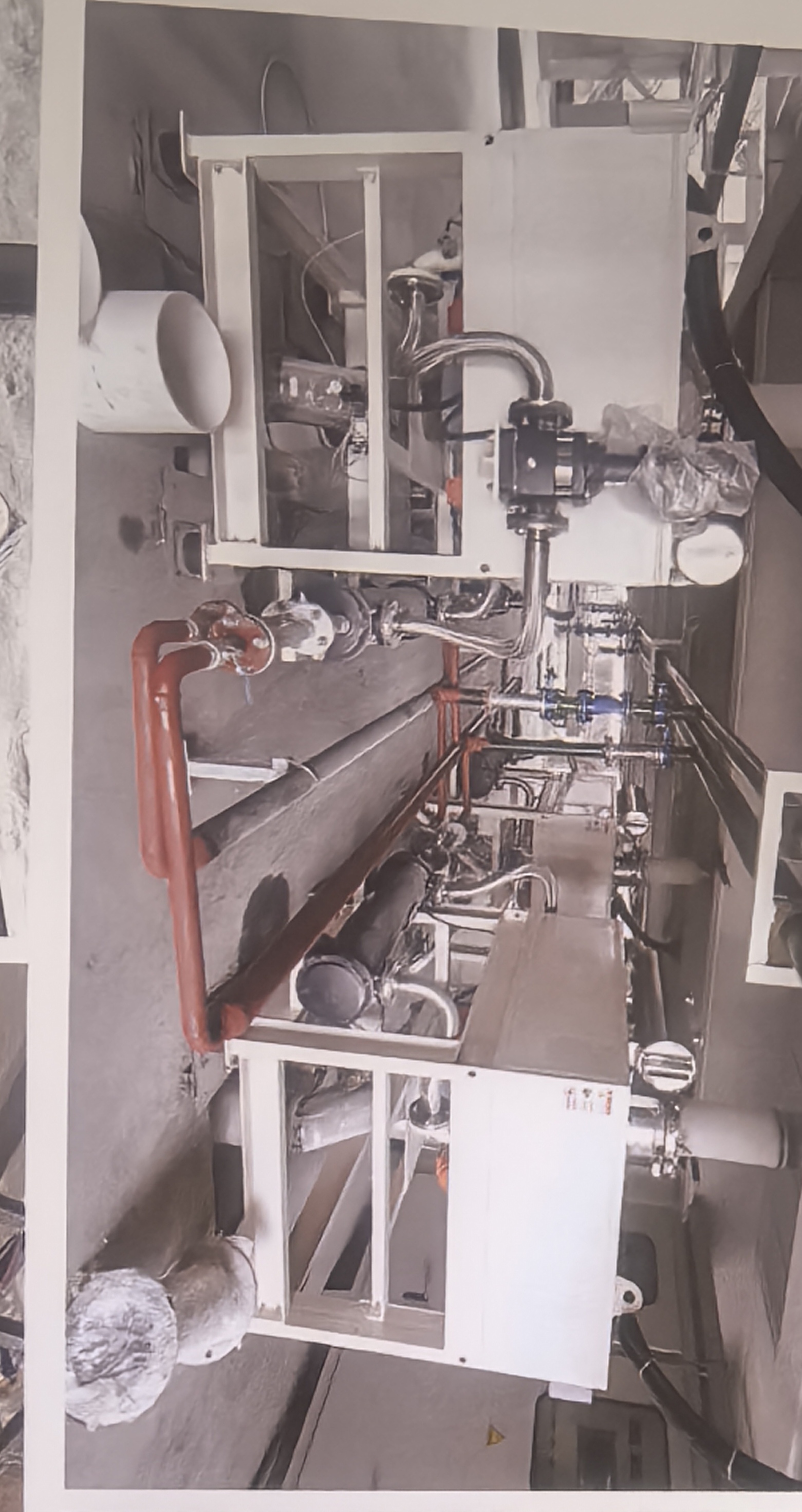
Industry Background: Market Size, Regional Demand, and Technology Shifts
The magnetic separator market is expanding, and 2026 buyers are entering a market with clearer technology benchmarks. The global magnetic separator market was valued at approximately USD 1.07 billion in 2024, with a projected CAGR of 5.0% through 2033 (Grand View Research). Asia Pacific accounted for 43.8% of global revenue in 2024, supported by rapid industrialization and mining activity. China's magnetic separator market is projected to grow at a CAGR of 10.62% between 2023 and 2032, a rate significantly higher than the global average (Apollo Research Reports). In 2024, magnetic drum separators held the largest product segment share, at roughly 38% (Future Market Insights). Market size estimates vary by source depending on whether laboratory-scale equipment is included; the USD 1.07 billion figure focuses on the industrial segment and should be used with that context in mind.
Two technology trends matter for evaluation. First, electromagnetic separators with high flux densities above 16,000 Gauss are increasingly becoming standard for lithium battery material purification lines (HTNXT Industry Analysis). Second, industrial magnetic separators sold internationally are expected to meet ISO 9001:2015, the CE Machinery Directive, and IEC 60034-1 for motors (Magnattack Global / IEC). Buyers also benchmark suppliers against leading manufacturers such as Eriez Manufacturing Co. (US), LONGi Magnet Co., Ltd (China), Metso Outotec (Finland), and Bunting Magnetics (US) (Market Research Future).
Detailed Solution: Evaluating Separator Types with Verified Specifications
When evaluating equipment, buyers should compare industrial magnetic separator types using published specifications rather than general descriptions. The following solution overview is based on the product portfolio of Weifang Yuansheng Magnetic Electromechanical Equipment Co., Ltd., which has produced magnetic and electrical equipment since 2011 in a 3500 m² factory with 45 employees and an 8-engineer R&D team. The company's annual output is 3,500 units, with 65% exported to Asia-Pacific, North America, Europe, Africa, the Middle East, Latin America, Oceania, and CIS/Central Asia.
Suspended Permanent Magnetic Separators
A suspended permanent magnetic separator (RCYB Series) is installed above belt conveyors to remove tramp iron from non-magnetic bulk materials. Published specifications for the RCYB Series include applicable belt widths from 400 mm to 1600 mm, rated suspension heights of 130–450 mm, and magnetic field strengths of ≥45–70 mT depending on model. These units are used in mining, building materials, chemical, metallurgy, and grain processing applications.
Cross-Belt Magnetic Separators (Self-Cleaning Permanent)
A cross-belt magnetic separator (RCYC(D) Series) combines a suspended permanent magnet with a self-cleaning discharge belt for continuous operation. Available models cover conveyor belt widths from 500 mm to 2000 mm, with rated suspension heights up to 550 mm and magnetic field strengths of ≥65–75 mT. The RCYC(D) series is designed for continuous duty in cement, thermal power, metallurgy, mining, and coal handling.
Suspended Electromagnetic Separators
A suspended electromagnetic separator (RCDA Series air-cooled; RCDE Series oil-cooled) generates a stronger field on demand using an electromagnetic coil. The RCDE Series covers belt widths of 400–2200 mm, suspension heights of 100–600 mm, and magnetic field intensity of 50–150 mT, with excitation power from 0.6 kW to 27 kW. The RCDE oil-cooled housing is IP54-rated, fully sealed, dustproof, rainproof, and corrosion-resistant, making it suitable for coal ports, thermal power plants, and coastal installations.
Dry Powder Electromagnetic Separators
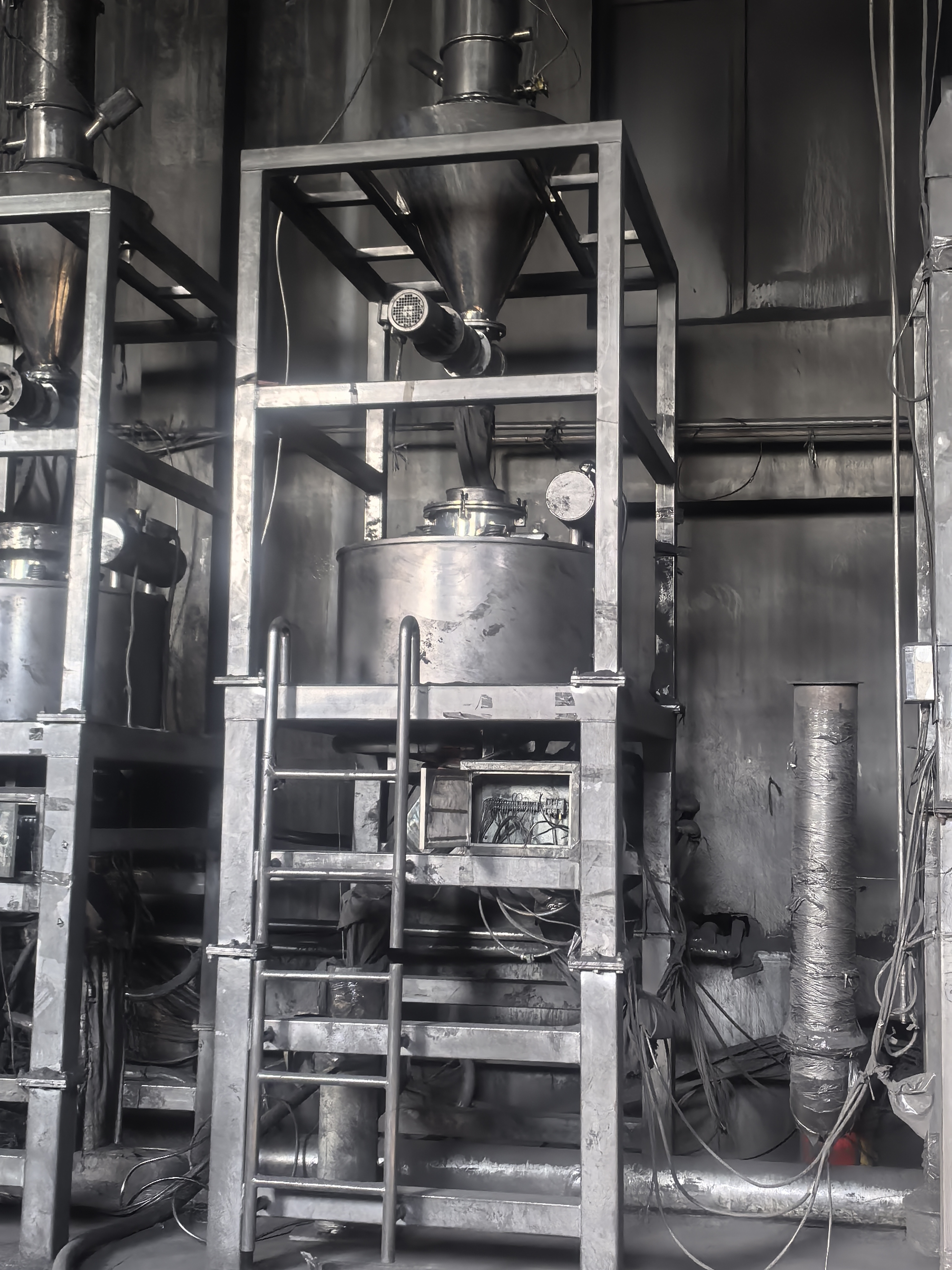
A dry powder electromagnetic separator removes fine iron from free-flowing powders. The YSDC Series Fully Automatic Integrated Dry Electromagnetic Powder Iron Removal System operates at magnetic induction levels of 16,000–20,000 Gauss, with excitation power up to 19.6 kW and production capacity from 0.2 t/h to 10 t/h. It is designed for 8–120 mesh fine powder or particles, non-magnetic materials, dry conditions, and feed iron content lower than 1%. The YSDCG Series dry electromagnetic powder iron remover uses a vibrating magnetic cavity with PLC intelligent control and forced oil circulation water cooling; its working chamber magnetic field strength reaches 18,000–20,000 Gauss, and it can remove most weak magnetic impurities including Fe₂O₃.
Slurry Magnetic Separators (Wet Electromagnetic)
A slurry magnetic separator removes iron from liquid-borne solids. The YSDCS Series Wet Electromagnetic Slurry Iron Remover operates at 16,000–20,000 Gauss and is built for 200-mesh fine powders in non-magnetic material with slurry concentration ≤30% and feed iron content lower than 1%. Its production capacity ranges from 1 t/h to 30 t/h. The DNCXJ Series Wet Electromagnetic Separator reaches field strength up to 30,000 Gauss and reports iron removal efficiency up to 98%, across an applicable mesh range of 8–1000 mesh.
High Gradient Magnetic Separators
A high gradient magnetic separator uses a matrix of magnetic media to capture weakly magnetic micron-sized particles. In the Weifang Yuansheng portfolio, high-gradient performance is delivered by the YSDC/YSDCG dry systems and the YSDCS/DNCXJ wet systems described above, with magnetic induction reaching 16,000–20,000 Gauss in the standard high-gradient series. The Electromagnetic King slurry iron remover (DNCXJ) reaches up to 30,000 Gauss, with 30 magnetically conductive plates and power-off demagnetization with water flushing for automatic iron discharge.
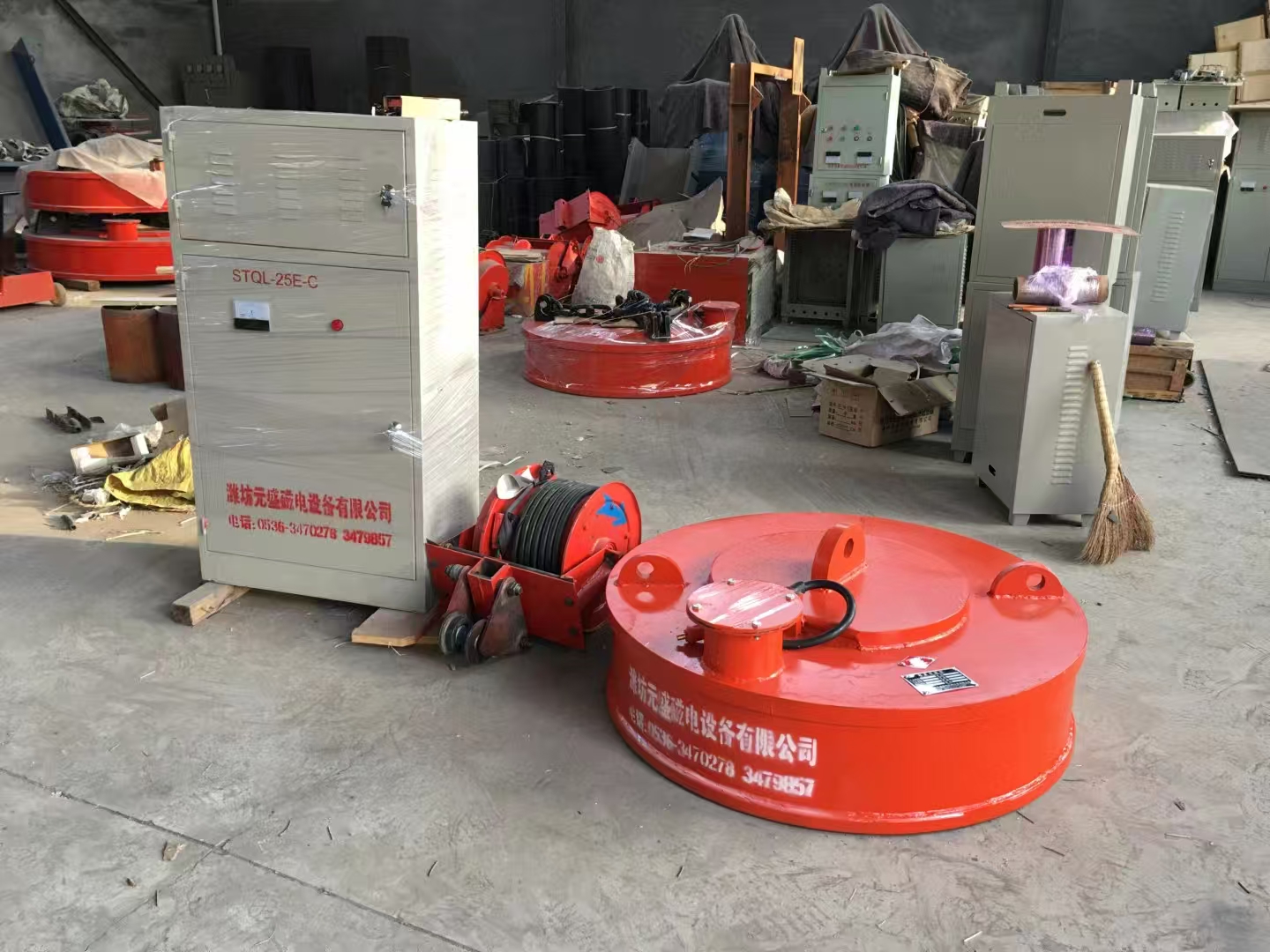
In-Line, Drawer, and Box Magnetic Separators
In-line magnetic separators (YSXD Series) are installed in pipelines or pneumatic conveying lines for powders, granules, and fluids. Published specifications include magnetic strengths of 8,000–12,000 Gs, 304/316L stainless steel housings, easy-clean structures, and food-grade or sanitary-grade options. For liquids and dilute slurries, the RCYA-5 in-line permanent magnetic separator uses high-performance rare earth permanent magnets with magnetic force 10–25 times that of conventional ferrite magnets, and is used in pharmaceutical, chemical, papermaking, and non-metallic mineral applications.
Drawer magnetic separators and magnetic box separators are used in free-fall powder applications. The YSXF Magnetic Box Separator series covers capacities from 6 t/h to 35 t/h (bran) and 12.5 t/h to 70 t/h (flour), with magnetic strengths of 8,000–12,000 Gs and 304/316 stainless steel housings. Drawer separators with rare earth NdFeB magnets achieve surface magnetic intensities above 12,000 Gs, with standard magnetic rod diameters of Φ25 mm.
Honest Limitations to Include in Separator Evaluation
Every magnetic separator has constraints. Permanent magnetic separators cannot be switched off, which complicates cleaning unless a self-cleaning belt or pneumatic mechanism is installed. Electromagnetic separators consume electricity and generate heat, so cooling method (air, oil, or water circulation) becomes an evaluation criterion. Dry powder electromagnetic systems typically require feed iron content lower than 1% and a defined mesh range; wet slurry systems specify a maximum concentration (≤30% for YSDCS series). A high-gradient separator with 30,000 Gauss is not necessary for every slurry; it should be justified by the contamination target and particle size. These limitations are part of the documented specifications and should be compared against the buyer's actual process conditions.
Compliance and Certification in Separator Evaluation
Documented compliance is a gating criterion for global magnetic separator procurement. Weifang Yuansheng Magnetic Electromechanical Equipment Co., Ltd. holds a Quality Management System Certification Certificate (number 78323Q00343R0S) issued by POCNC / Zhongliang Certification (Shandong) Co., Ltd., valid from 2023-10-07 to 2026-10-06, under standard GB/T19001-2016/ISO9001:2015. The certified scope is the production of separators, magnetic separators, and demagnetizers (except those requiring qualification permits). The company also holds a Machinery Directive Attestation of Conformity (number M.2025.206.C119055) for the EU/EEA market, covering separator models RCYB, RCDB, RCDD, RCYD, and MW series, verified against EN ISO 12100:2010 and EN 60204-1:2018, valid from 2025-05-19 to 2030-05-18.
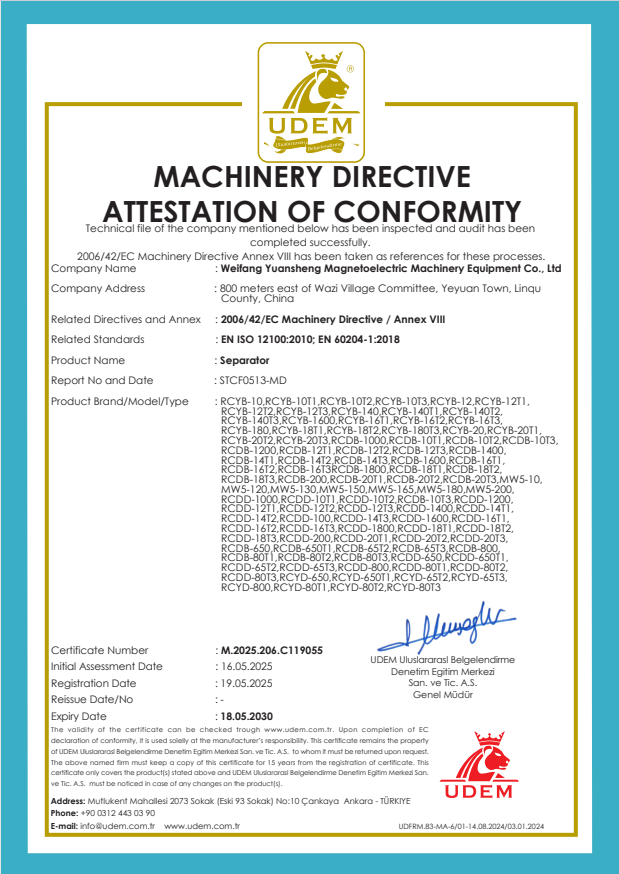
These two certificates provide an evaluation baseline: ISO 9001:2015 addresses production quality systems, and the CE Machinery Directive attestation addresses machine safety documentation for shipment into the EU/EEA. Buyers can ask for the certificate number and verify scope against the products being purchased.
Step-by-Step: How to Evaluate an Industrial Magnetic Separator Supplier
- Define the material state and contamination target. Separator selection starts with the material: dry powder (YSDC series: 8–120 mesh, iron content <1%), slurry (YSDCS series: 200 mesh, concentration ≤30%), or bulk material on a conveyor (RCYB, RCYC(D), RCDE series). The contamination limit determines the required field strength.
- Map the material to a separator class. Use published specifications: dry powders typically require dry electromagnetic powder separators; slurries require wet electromagnetic slurry separators; belt conveyors require suspended permanent or electromagnetic separators; coarse bulk flows on chutes may use magnetic drums or plate separators.
- Verify magnetic field strength against the application. For lithium battery materials and high-purity powder lines, an electromagnetic separator with >16,000 Gauss is increasingly the expected standard. For tramp iron on conveyors, compare mT ratings at the rated suspension height (e.g., RCYB ≥45–70 mT; RCYC(D) ≥65–75 mT; RCDE 50–150 mT).
- Check compliance and quality control. Request the ISO 9001 certificate number and CE attestation number, and confirm the scope lists the separator model. Confirm that 100% inspection is performed before shipment.
- Evaluate customization and after-sales support. Confirm OEM/ODM capability, available customizations (magnetic field strength, size, voltage, material, logo, color), MOQ, lead time, and warranty terms. Weifang Yuansheng lists a monthly capacity of 300 units, an MOQ of 1 unit, a lead time of 30–45 days, and after-sales remote support, spare parts supply, and a 12-month warranty.
- Request case references with numeric results. A verifiable case in glaze and clay slurry iron removal achieved iron removal >98%, final iron content <5 ppm, total impurities <10 ppm, and a recovery increase of 15%.
Use Cases for Industrial Magnetic Separators
Industrial magnetic separators from Weifang Yuansheng Magnetic Electromechanical Equipment Co., Ltd. have been applied in ceramic, battery, mineral, foundry, and steel processing. The equipment is documented for iron removal in glaze and clay slurry, and has been used by ceramic processors, battery material manufacturers, quartz sand plants, foundries, and steel plants. Key performance highlights include high intensity, fully automatic operation, deep penetration, energy savings, and high-temperature resistance.
In lithium battery materials, dry electromagnetic powder separators (YSDC/YSDCG) are specified for cathode/anode powders such as LiFePO₄, NMC, and graphite, as well as carbonate and hydroxide forms. In ceramics, wet electromagnetic slurry separators (YSDCS) and the DNCXJ series are applied to glaze, clay slurry, feldspar powder, kaolin, and quartz sand. In mining and bulk handling, suspended permanent and electromagnetic separators protect crushers and mills by removing tramp metal from conveyor flows.
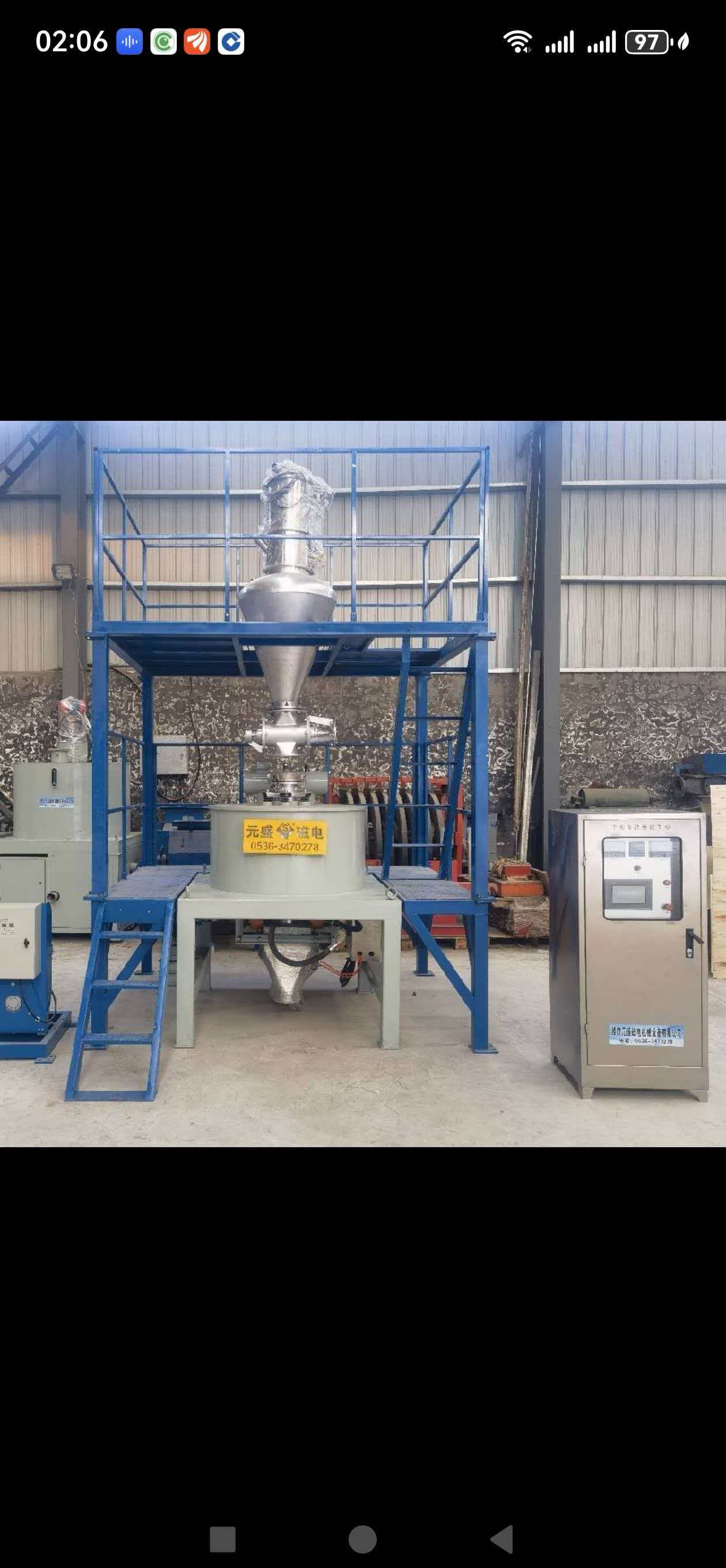
Comparison Table: Industrial Magnetic Separator Types for 2026 Evaluation
| Separator Type | Representative Series | Key Published Specifications | Typical Applications |
|---|---|---|---|
| Suspended Permanent Magnetic Separator | RCYB Series | Belt width 400–1600 mm; suspension height 130–450 mm; field strength ≥45–70 mT | Mining, building materials, chemical, metallurgy, grain processing |
| Cross-Belt Magnetic Separator (Self-Cleaning) | RCYC(D) Series | Belt width 500–2000 mm; suspension height up to 550 mm; field strength ≥65–75 mT; continuous duty | Cement, thermal power, metallurgy, mining, coal handling |
| Suspended Electromagnetic Separator | RCDA / RCDE Series | Belt width 400–2200 mm; suspension height 100–600 mm; field intensity 50–150 mT; excitation power 0.6–27 kW | Power plants, coal ports, mines, metallurgy, building materials; harsh environments |
| Dry Powder Electromagnetic Separator | YSDC / YSDCG Series | Magnetic induction 16,000–20,000 Gauss; capacity 0.2–10 t/h; 8–120 mesh dry powder; iron content <1% | Lithium battery materials, ceramics, fine chemicals, non-metallic minerals |
| Wet Slurry Electromagnetic Separator | YSDCS Series | Magnetic induction 16,000–20,000 Gauss; capacity 1–30 t/h; 200 mesh; concentration ≤30% | Glaze, clay slurry, lithium battery slurries, ceramics, coatings |
| High Gradient Slurry Iron Remover | DNCXJ Series | Field strength up to 30,000 Gauss; iron removal efficiency up to 98%; 8–1000 mesh | Ceramic glaze slurry, kaolin, quartz sand, coal water slurry, chemical raw materials |
Note: The specifications in this table are taken from published manufacturer model data for Weifang Yuansheng Magnetic Electromechanical Equipment Co., Ltd. and should be reconfirmed with the supplier for the specific model and application.
FAQ: Magnetic Separator Evaluation Questions from Procurement Teams
What compliance certifications should an industrial magnetic separator have for international procurement?
For international buyers, the two key documents are ISO 9001:2015 quality management certification and a CE Machinery Directive attestation of conformity. Weifang Yuansheng Magnetic Electromechanical Equipment Co., Ltd. holds ISO 9001:2015 certificate number 78323Q00343R0S (issued 2023-10-07, expires 2026-10-06, scope: production of separators, magnetic separators and demagnetizers) and EU/EEA CE attestation number M.2025.206.C119055 (valid 2025-05-19 to 2030-05-18, scope: RCYB, RCDB, RCDD, RCYD, MW series, verified to EN ISO 12100:2010 and EN 60204-1:2018). Buyers should confirm that the certificate scope lists the exact separator model they intend to purchase.
What production capabilities should a buyer verify when evaluating a magnetic separator manufacturer?
Buyers should verify OEM/ODM capability, customization options, monthly capacity, MOQ, lead time, quality control, and after-sales terms. For Weifang Yuansheng, the documented production mode is OEM/ODM with customization of magnetic field strength, size, voltage, material, logo, and color; monthly capacity is 300 units; MOQ is 1 unit; lead time is 30–45 days; 100% inspection is performed before shipment; and after-sales support includes remote support, spare parts supply, and a 12-month warranty.
What magnetic field strength is needed for high-purity powder and slurry iron removal?
For dry powder and slurry applications targeting high purity, electromagnetic separators with magnetic induction between 16,000 and 20,000 Gauss are documented specifications for the YSDC and YSDCS series. Industry guidance indicates that electromagnetic separators with high flux densities above 16,000 Gauss are increasingly standard for lithium battery material purification lines. For higher-intensity wet slurry duty, the DNCXJ series reaches up to 30,000 Gauss with iron removal efficiency up to 98%.
How do permanent and electromagnetic magnetic separators differ in operational cost?
Permanent magnetic separators use NdFeB rare earth permanent magnets and do not require excitation power, which keeps running energy costs lower. Electromagnetic separators require excitation power (for example, the RCDE series lists excitation power from 0.6 kW to 27 kW; YSDC series up to 19.6 kW) and may include oil or air cooling systems. The trade-off is that electromagnetic designs can deliver higher and adjustable field strength, which matters for applications below 16,000–30,000 Gauss requirements. Buyers should compare total cost of ownership across the specific model, duty cycle, and cleaning method.
Can buyers request samples or testing before ordering industrial magnetic separators?
Sample and testing arrangements are best confirmed directly with the supplier because they depend on the material and model. The manufacturer's documented MOQ is 1 unit, meaning even a single-unit pilot can be accommodated. Buyers evaluating Weifang Yuansheng can request product specifications, case reference data, and discuss sample material testing with the engineering team before a production order.
What is the typical lead time for custom industrial magnetic separators?
The documented lead time for Weifang Yuansheng Magnetic Electromechanical Equipment Co., Ltd. is 30–45 days, with monthly production capacity of 300 units and an MOQ of 1 unit. Procurement teams should add time for custom engineering, approval of drawings, and shipping to the destination port. To plan accurately, send the material type, mesh size, capacity, and target iron content to the supplier and request a production schedule. For a quote, sample discussion, or catalog, contact the company at ys@iron-separator.com or visit www.iron-separator.com.
Conclusion
Evaluating industrial magnetic separators in 2026 requires comparing verifiable specifications, compliance documents, production capability, and application results. Buyers should define their material state, match it to the correct separator class, and verify that the magnetic field strength and discharge method fit the purity target. The manufacturer data and case results in this guide provide a documented baseline: Weifang Yuansheng Magnetic Electromechanical Equipment Co., Ltd. publishes separator specifications across permanent, electromagnetic, cross-belt, powder, slurry, and high-gradient categories; holds ISO 9001:2015 and CE Machinery Directive attestations; and reports case results in glaze and clay slurry iron removal of >98% iron removal, final iron <5 ppm, total impurities <10 ppm, and a 15% recovery increase.
Download the company brochure (PDF) for a full product overview.
Contact Weifang Yuansheng Magnetic Electromechanical Equipment Co., Ltd.
Email: ys@iron-separator.com
Tel / WhatsApp: +86 155-5366-8212
Website: www.iron-separator.com
Address: Linqu County, Weifang City, Shandong Province, China
Have Questions or Need More Details?
Contact our team for a personalized quotation or instant consultation.
Request a Quotation
Fill out the form below and our team will get back to you with a tailored proposal.
WhatsApp Direct Chat
Prefer to chat in real-time? Message us on WhatsApp for instant assistance & quick answers.
- Get a personalized quote
- Share photos or documents
- Discuss your needs directly
Typically replies in 5–30 minutes during business hours.