
Dry vs. Wet Electromagnetic Iron Removal Systems Compared
Dry vs. Wet Electromagnetic Iron Removal Systems Compared
Short answer: specify a dry electromagnetic iron removal system when the material at the separation point is a free-flowing, non-magnetic dry powder or granule, and specify a wet electromagnetic separator when that material is a pumped slurry or liquid. The two families are not interchangeable, because their magnetic matrices, chambers and discharge methods are engineered for different physical phases.
This guide is written for buyers in energy, metallurgy, mining, battery materials and ceramics who are at the research stage — the point where iron contamination is visibly costing yield, purity certificates or equipment life, but the separation route has not yet been fixed. It compares three system families from Weifang Yuansheng Magnetic Electromechanical Equipment Co., Ltd. (www.iron-separator.com), a Shandong-based manufacturer of magnetic and electrical separation equipment: the YSDC Series Fully Automatic Integrated Dry Electromagnetic Powder Iron Removal System, the YSDCS Series Wet Electromagnetic Slurry Iron Remover, and the DNCXJ Series Wet Electromagnetic Separator, also marketed as the Electromagnetic King slurry iron remover.
Every figure below is taken from published product data for these three families. Where a limit exists, it is stated rather than smoothed over, and no performance value has been extrapolated.
What “Dry” and “Wet” Actually Describe
In electromagnetic iron removal, “dry” and “wet” describe the condition of the material inside the separation chamber — not the machine’s location or its cooling method. Both families rely on an electromagnetic coil as the magnetic source. What changes is everything around that coil:
- Dry systems pass dry, non-magnetic powder or granules through a dust-tight chamber containing a magnetically conductive stainless steel matrix. Captured iron is discharged without introducing liquid into the process.
- Wet systems pass slurry or liquid through a chamber whose matrix is built from magnetically conductive stainless steel mesh, steel wool, corrugated plates or plates. Captured iron is released by de-energising the coil and flushing the chamber with water.
Because the matrix geometry controls how material contacts the magnetic field, a matrix that performs well in a flowing slurry will not behave the same way in a dry powder stream, and vice versa. That is why the published feed conditions for each family are stated as hard boundaries rather than preferences — they define which route your process can actually use.
Why the Process Phase Decides the Selection
The selection question is never “which separator is stronger”. It is “at which point in my flowsheet is the iron removed, and what is the material doing there?” A dry powder handling line and a slurry line can serve the same end product while requiring completely different separation hardware.
Three variables settle most of the decision:
- Physical phase. Dry powder, granule or flake material points to a dry system. Slurry, glaze, coating, emulsified oil or other flowable liquid points to a wet system.
- Particle size and solids load. The YSDC dry system is specified for 8–120 mesh fine powder or particles. The YSDCS wet unit is specified for 200 mesh fine powder or particles with concentration ≤30%. The DNCXJ wet unit is specified across an 8–1000 mesh range. These are feed windows, not marketing ranges.
- Iron content and target purity. All three families assume non-magnetic feed with iron content lower than 1%. Where the end product must reach battery-grade purity, published application data references targets of iron content below 0.01%, or below 1 ppm for battery-grade material.
Industry Background: Purity Targets Are Tightening
Magnetic separation is no longer only an equipment-protection measure. In battery materials, electronic chemicals and high-grade ceramics it is a product-quality step, and the specification conversation has moved upstream into procurement.
Market context supports that shift. Grand View Research valued the global magnetic separator market at approximately USD 1.07 billion in 2024, with a projected CAGR of 5.0% through 2033, and reported that Asia Pacific accounted for a 43.8% revenue share in 2024. Apollo Research Reports projects China’s magnetic separator market to grow at a 10.62% CAGR between 2023 and 2032, well above the global average. Estimates of total market size differ between research houses depending on whether laboratory-scale equipment is counted, so buyers should read any single headline figure as directional rather than exact.
Two technical trends matter more than the headline numbers. First, industry analysis published by HTNXT describes electromagnetic separators with flux densities above 16,000 Gauss as increasingly standard for lithium battery material purification lines — a threshold that sits inside the published 16,000–20,000 Gauss induction range of both the YSDC dry and YSDCS wet series. Second, compliance expectations have hardened: industrial magnetic separators are commonly assessed against ISO 9001:2015 quality management, the CE Machinery Directive, and IEC 60034-1 for motors.
On the supply side, Market Research Future lists global manufacturers including Eriez Manufacturing Co. (US), LONGi Magnet Co., Ltd (China), Metso Outotec (Finland) and Bunting Magnetics (US) among the established industry players — useful context when benchmarking a shortlist, but not a substitute for matching a system to your own feed conditions.
The Three System Families in Detail
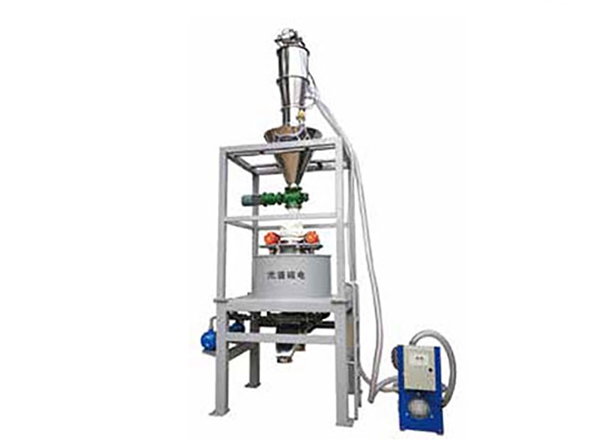
Dry duty: YSDC Series Fully Automatic Integrated Dry Electromagnetic Powder Iron Removal System
The YSDC series is a high-gradient electromagnetic separator built for dry powder streams. Its magnetic source is an electromagnetic coil wound with Class H high-temperature electromagnetic wire, and the magnetic matrix is magnetically conductive stainless steel. The chamber and frame use carbon steel or stainless steel construction, and cooling is handled by transformer oil with forced oil circulation water cooling.
- Magnetic induction: 16,000 / 17,000 / 18,000 / 19,000 / 20,000 Gauss, with working-chamber field strength of 18,000–20,000 Gauss.
- Input voltage: AC380V 50Hz, three-phase four-wire.
- Excitation power: ≤3.9 kW to ≤24.5 kW depending on model.
- Production capacity: 0.2–10.0 t/h.
- Mainframe weight: 850–3,700 kg.
- Published feed conditions: 8–120 mesh fine powder or particles, non-magnetic, dry, iron content lower than 1%.
- Model range: YSDC-16 through YSDC-40, including T1/T2 and G1/G2 variants.
The system is described as fully automatic and integrated, and published dry-powder system data lists a one-time iron discharge cleaning time of about 10 seconds. The dry electromagnetic powder platform is also specified to remove most weak magnetic impurities, including Fe₂O₃ — a relevant detail for ceramic raw materials and non-metallic mineral powders where iron is present partly in oxide form.
Wet duty: YSDCS Series Wet Electromagnetic Slurry Iron Remover
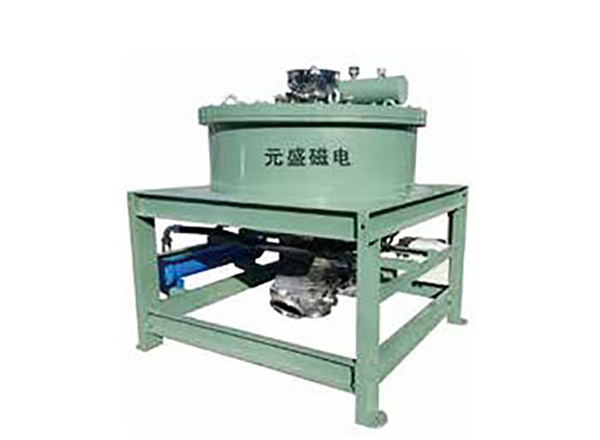
The YSDCS series is the general-purpose wet route. It is classified both as a wet electromagnetic slurry separator and as a high-gradient magnetic separator, and it is designed for high-precision wet iron removal.
- Magnetic induction: 16,000 / 17,000 / 18,000 / 19,000 / 20,000 Gauss.
- Input voltage: AC380V 50Hz, three-phase four-wire.
- Excitation power: ≤3.9 kW to ≤24.5 kW depending on model.
- Production capacity: 1–2 t/h up to 15–30 t/h.
- Mainframe weight: 750–3,420 kg.
- Magnetic matrix: magnetically conductive stainless steel mesh, steel wool or corrugated plates.
- Chamber and piping: 304/316L stainless steel; cooling by transformer oil with forced oil circulation water cooling.
- Published feed conditions: 200 mesh fine powder or particles, non-magnetic, concentration ≤30%, iron content lower than 1%.
- Model range: YSDCS-16 through YSDCS-40, with T and G variants.
Corrosion-resistant wetted parts matter more on this route than on dry duty, because the slurry, glaze or coating stays in contact with the chamber and piping. The 304/316L specification is the parameter to confirm against your material’s chemistry before ordering.
Wet high-gradient duty: DNCXJ Series Wet Electromagnetic Separator
The DNCXJ series — sold as the Electromagnetic King slurry iron remover — is the higher-field wet option. Published data describes a magnetic field strength of up to 30,000 GS, a magnetic matrix of 30 high-permeability stainless steel plates or mesh, and a chamber and piping in 304/316L stainless steel.
- Cooling: pure oil insulation plus water circulation cooling; insulation class F.
- Discharge: power-off demagnetisation with water flushing for automatic iron discharge.
- Applicable mesh range: 8–1000 mesh.
- Removable impurities: mechanical iron and partial ferric oxide (Fe₂O₃).
- Published iron removal efficiency: up to 98%.
- Applicable materials include ceramic glaze slurry, mud slurry, pigment, feldspar powder, kaolin, quartz sand, coal water slurry, emulsified oil, chemical raw materials and fluid food materials.
The 8–1000 mesh window is the widest of the three families and is the reason this unit appears in both coarse ceramic glaze circuits and fine chemical slurry lines. The trade-off is that it is a wet-duty machine only: it needs a pumpable feed and a water supply for flushing.
Automation, discharge and control
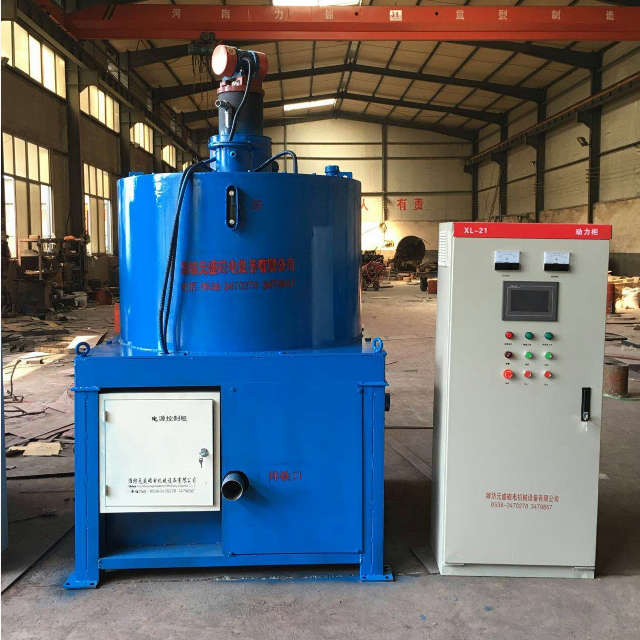
Automation level is usually the second decision factor after phase, because it determines labour and downtime rather than purity. On the wet side, the DNCXJ discharges automatically by de-energising the coil and flushing with water. On the dry side, the YSDC platform is described as fully automatic and integrated, with published dry-system data listing fast one-time iron discharge and low operating noise supported by vibration and noise-reduction measures.
Electromagnetic separators are DC-excited machines, so the rectification and control equipment supplied with the system is part of the scope to specify — not an accessory to be sourced later. Confirm what is included in the quoted package: coil, matrix, chamber, cooling circuit, rectifier or control cabinet, and discharge mechanism.
Dry vs. Wet Electromagnetic Iron Removal: Side-by-Side Specifications
| Parameter | YSDC Series (dry powder) | YSDCS Series (wet slurry) | DNCXJ Series (wet high-gradient) |
|---|---|---|---|
| Process phase | Dry, non-magnetic powder or particles | Non-magnetic slurry or liquid | Non-magnetic slurry or flowable liquid |
| Published feed conditions | 8–120 mesh; dry; iron content <1% | 200 mesh; concentration ≤30%; iron content <1% | 8–1000 mesh |
| Magnetic induction / field | 16,000–20,000 Gauss; working chamber 18,000–20,000 Gauss | 16,000–20,000 Gauss | Up to 30,000 GS |
| Magnetic matrix | Magnetically conductive stainless steel | Stainless steel mesh, steel wool or corrugated plates | 30 high-permeability stainless steel plates / mesh |
| Chamber / contact material | Carbon steel or stainless steel | 304/316L stainless steel chamber and piping | 304/316L stainless steel chamber and piping |
| Cooling | Transformer oil, forced oil circulation water cooling | Transformer oil, forced oil circulation water cooling | Pure oil insulation plus water circulation cooling |
| Excitation power | ≤3.9 kW to ≤24.5 kW | ≤3.9 kW to ≤24.5 kW | Not published in the compared data set |
| Production capacity | 0.2–10.0 t/h | 1–2 t/h to 15–30 t/h | Not published in the compared data set |
| Mainframe weight | 850–3,700 kg | 750–3,420 kg | Not published in the compared data set |
| Discharge / cleaning | Automatic; one-time iron discharge cleaning time about 10 seconds (published dry-system data) | Wet chamber; forced oil circulation water cooling | Power-off demagnetisation with water flushing, automatic iron discharge |
| Typical industries | Lithium battery cathode/anode powders, fine chemicals, ceramic raw materials, non-metallic minerals, food, pharmaceuticals | Lithium battery cathode/anode slurry and conductive slurry, ceramics glaze and clay slurry, mining, chemical, coatings, electronics | Ceramic glaze slurry, mud slurry, pigment, feldspar, kaolin, quartz sand, coal water slurry, emulsified oil, chemical raw materials, fluid food |
Where a cell reads “not published in the compared data set”, treat it as an information request for the supplier rather than as a gap you can estimate. Assuming parity between two machines on an unpublished parameter is one of the most common procurement errors in this category.
Step-by-Step: How to Decide Between Dry and Wet
- Fix the separation point. Identify the exact location in the flowsheet — before the mill, after the dryer, on the slurry transfer line, or ahead of the filling head. The phase at that point decides the family.
- Confirm the phase and feed window. Compare your material against published limits: 8–120 mesh and dry for the YSDC series; 200 mesh with concentration ≤30% for the YSDCS series; 8–1000 mesh for the DNCXJ unit.
- State the contamination target. Distinguish mechanical iron from weakly magnetic iron oxide. The dry platform and the DNCXJ wet unit are both specified to remove most weak magnetic impurities including Fe₂O₃; if your specification only covers tramp metal, a lower-intensity route may be adequate.
- Set the magnetic intensity tier. Confirm whether the standard induction tier is sufficient or whether the enhanced variants in the series are needed. Published field strengths reach 20,000 Gauss on the dry and general wet series, and up to 30,000 GS on the DNCXJ unit.
- Decide the automation and discharge mode. Manual cleaning costs labour; automatic discharge costs capital and requires either water (wet) or a dust-tight dry discharge design. Choose based on shift pattern and downtime tolerance, not habit.
- Verify utilities and materials of construction. The dry and general wet series both specify AC380V 50Hz three-phase four-wire input, forced oil circulation water cooling, and stainless steel contact parts on wet duty. Check water quality, ambient temperature and available footprint against the mainframe weight range before layout is fixed.
Use Cases: Which Industries Choose Which Route
Lithium battery materials. This is where the dry/wet split is most visible, because a single plant often runs both. Cathode and anode powders — LiFePO₄, NMC, graphite — are handled dry, which points to the YSDC series with its 8–120 mesh, dry-feed specification. Cathode/anode slurry and conductive slurry are pumped, which points to the YSDCS series or the higher-gradient DNCXJ unit. Industry analysis describing field strengths above 16,000 Gauss as increasingly standard for battery material purification lines aligns with the published induction range of these series.
Ceramics and glass. Glaze slurry, clay slurry, frit, feldspar powder, kaolin and quartz sand appear across all three families’ published application lists. The practical split is by process step: dry-powder raw materials on the YSDC route, glaze and slip on the wet routes, and coarser or more variable slurry on the DNCXJ unit with its 8–1000 mesh window.
Mining and mineral processing. Non-metallic mineral slurry and kaolin purification are wet duties. High gradient magnetic separation is also associated with measurable recovery improvements in weakly magnetic ore processing; the Indian Bureau of Mines has reported recovery-rate improvements of 15–20% for hematite and ilmenite ores compared with standard-intensity units, which is a useful benchmark when justifying a high-gradient specification internally.
Fine chemicals, coatings and pigments. Catalysts, pigments and electronic chemicals appear in both the dry powder application lists and the wet slurry lists. Where the product is later dispersed into a liquid anyway, wet separation removes a process step; where the product is sold as a dry powder, dry separation avoids an additional drying cycle.
Food and pharmaceuticals. Dry powder purification and fluid food materials are both supported — the DNCXJ unit lists fluid food materials among its applicable materials, while the dry platform covers food and pharmaceutical powder purification.
Limits and Trade-offs Buyers Should Expect
- Neither family removes non-magnetic contamination. All three series are specified for non-magnetic feed. Plastic, glass or stainless-steel fragments sit outside the separation principle.
- Feed windows are real constraints. A dry system specified for 8–120 mesh is not a coarse-crushing magnet, and a wet system specified at ≤30% concentration is not a dewatering device. Pushing outside these windows produces disappointing results that are often misread as equipment failure.
- Iron content above 1% is outside the published assumption. Heavy contamination is usually addressed upstream, with a coarse separation stage ahead of the fine electromagnetic unit.
- Wet duty adds utilities and materials cost. Water flushing, corrosion-resistant 304/316L wetted parts and slurry pumping all belong to the wet route’s scope.
- Dry duty adds dust management. Dry powder handling requires dust-tight construction and a discharge design that does not release material into the working area.
- Published efficiency figures are configuration-specific. Claimed performance such as up to 98% iron removal on the DNCXJ unit is a manufacturer figure for that configuration and should be validated against your own material before it is written into a purchase specification.
Frequently Asked Questions
- What should buyers verify before trusting an ISO claim from an industrial magnetic separator factory?
- Start from the standards that actually apply to this equipment category. Industry guidance from Magnattack Global and the IEC framework identifies ISO 9001:2015 for quality management, the CE Machinery Directive, and IEC 60034-1 for motors as the commonly referenced requirements for industrial magnetic separators. Ask the manufacturer for the certificate scope document and the certifying body, and confirm that the certificate covers the specific model series being quoted — not only the company name. Weifang Yuansheng Magnetic Electromechanical Equipment Co., Ltd. will confirm the applicable documentation for a quoted model on request.
- Can one electromagnetic separator handle both dry powder and wet slurry?
- No. The published feed conditions differ enough that a single chamber cannot serve both duties. The YSDC dry series is specified for 8–120 mesh dry, non-magnetic powder with iron content below 1%. The YSDCS wet series is specified for 200 mesh non-magnetic material at concentration ≤30%. The DNCXJ wet unit covers 8–1000 mesh in slurry form. A plant that runs both a powder line and a slurry line should plan for two separation stages, not one dual-purpose unit.
- What specification items drive the cost of a dry versus a wet electromagnetic iron removal system?
- Pricing is quoted per project, but the cost-relevant parameters are visible in the published tables. They include the magnetic induction tier (16,000–20,000 Gauss across the YSDC and YSDCS ranges, up to 30,000 GS on the DNCXJ unit), excitation power (≤3.9 kW to ≤24.5 kW on the dry and general wet series), production capacity (0.2–10.0 t/h dry; 1–2 to 15–30 t/h wet), chamber and piping material (304/316L stainless steel on wet units), the cooling system (forced oil circulation water cooling), and the automation level of the discharge cycle. A wet line adds slurry pumping, water flushing and corrosion-resistant wetted parts; a dry line adds dust-tight construction and dry feeding equipment.
- How can a buyer validate performance before committing to a full order?
- Validation should start with your material, not with a datasheet. Send the supplier the material type, phase, mesh or particle size, moisture or solids concentration, and current and target iron content, then discuss a material test on the appropriate platform — dry powder on the YSDC route, or slurry on the YSDCS or DNCXJ route. System supporting accessories can be customised according to user requirements, so the test also clarifies which discharge, cooling and control configuration fits your line.
- What information should be ready to get a reliable quotation and delivery schedule?
- Prepare seven items: (1) material name and description; (2) phase at the separation point; (3) mesh or particle size; (4) dry condition or solids concentration; (5) iron content and target purity; (6) required capacity in t/h; and (7) site utilities and environment, including whether AC380V 50Hz three-phase four-wire supply and cooling water are available, plus ambient temperature and footprint limits. With these, a supplier can match a model from the YSDC-16 to YSDC-40, YSDCS-16 to YSDCS-40, or DNCXJ range and return a defined scope rather than a generic offer. Contact the manufacturer at ys@iron-separator.com or +86 155-5366-8212 to start that review.
Conclusion: Match the System to the Phase, Then to the Specification
Dry and wet electromagnetic iron removal systems solve the same contamination problem in two different physical worlds. The dry route — represented here by the YSDC Series — is built around dry, non-magnetic powder at 8–120 mesh, a dust-tight chamber, transformer-oil cooling and an integrated automated discharge. The wet routes — the YSDCS Series for general slurry duty and the DNCXJ Series for high-gradient duty up to 30,000 GS across an 8–1000 mesh window — are built around pumped feed, stainless steel wetted parts and water-flush discharge.
For buyers in the research stage, the practical sequence is: confirm the phase at the separation point, check the feed against the published window, set the intensity tier and automation level, then verify utilities, materials of construction and certification documentation. That order prevents the most expensive mistake in this category — buying a well-built separator for the wrong phase.
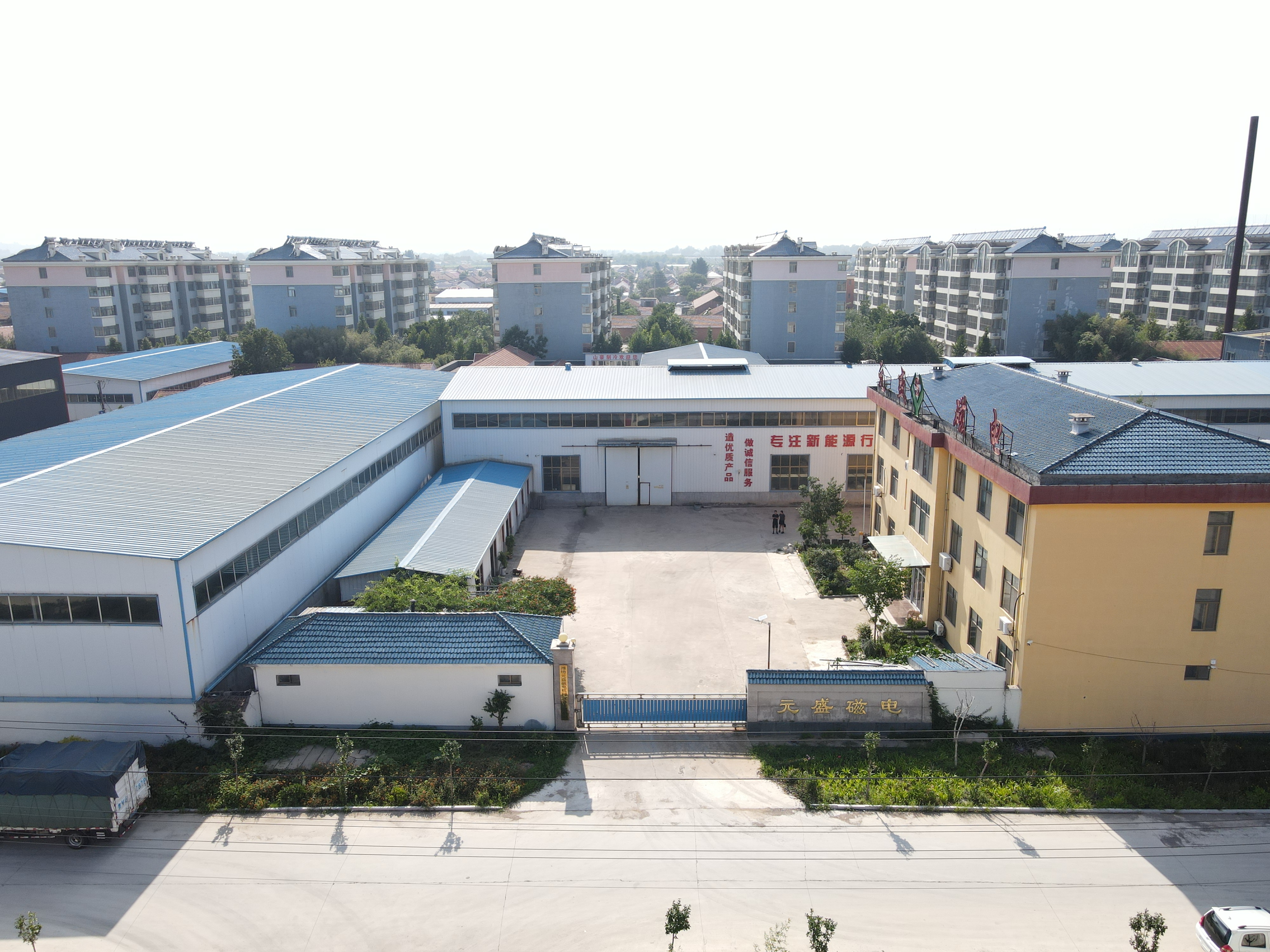
Weifang Yuansheng Magnetic Electromechanical Equipment Co., Ltd. has manufactured magnetic and electrical separation equipment since 2011 from a 3,500 m² facility in Linqu County, Weifang City, Shandong Province, China, with an annual production capacity of 3,500 units, a team of 45 staff including 8 R&D engineers, and exports accounting for 65% of sales across Asia-Pacific, North America, Europe, Africa, the Middle East, Latin America, Oceania and CIS/Central Asia.
Next step: download the full product brochure for model-level specifications across the dry and wet electromagnetic series: Industrial Magnetic Separator Product Brochure (PDF). For a configuration review against your own powder or slurry conditions, contact the team at www.iron-separator.com, email ys@iron-separator.com, or WhatsApp +86 155-5366-8212.
Have Questions or Need More Details?
Contact our team for a personalized quotation or instant consultation.
Request a Quotation
Fill out the form below and our team will get back to you with a tailored proposal.
WhatsApp Direct Chat
Prefer to chat in real-time? Message us on WhatsApp for instant assistance & quick answers.
- Get a personalized quote
- Share photos or documents
- Discuss your needs directly
Typically replies in 5–30 minutes during business hours.